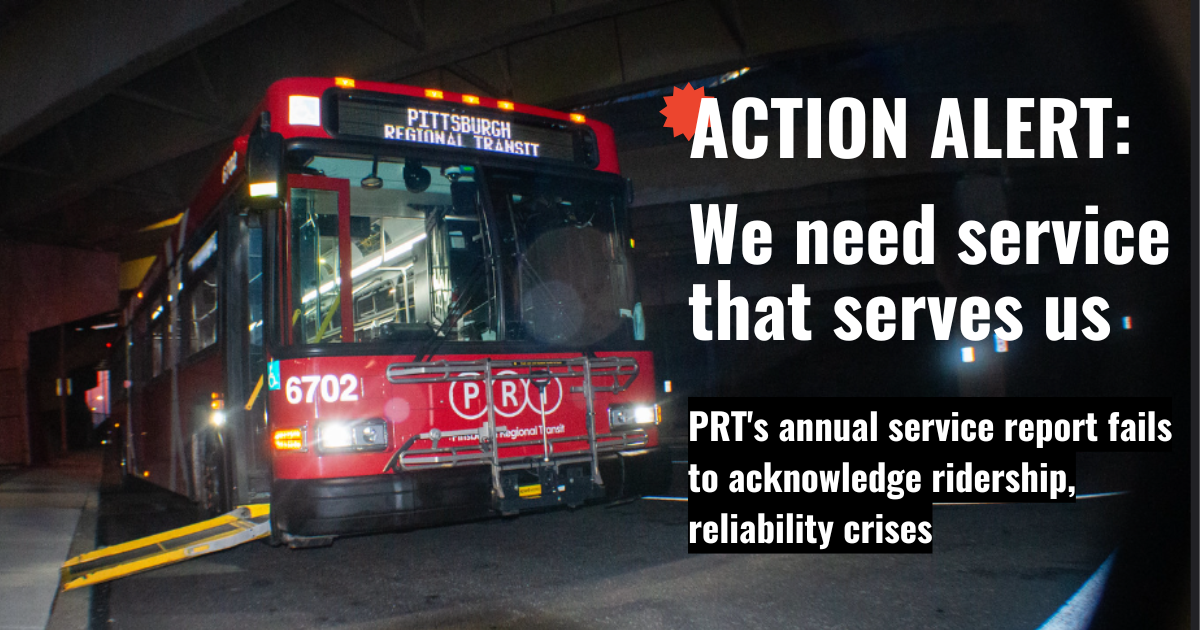
Image Description: a red PRT bus under a dark overpass at night, with its headlights on and ramp extended. To the right is white text reading “We need service that serves us: PRT’s annual service report fails to acknowledge ridership, reliability crises”, decorated with a red starburst.
We deserve a transit system worth fighting for. PRT’s ridership recovery post-COVID lags far behind its peers, and buses frequently don’t show up as scheduled.
Pittsburgh riders have proved they’re ready to go to bat for PRT. Now PRT needs to grow ridership and to improve service reliability—and implementing the Bus Line Redesign now isn’t the answer.
State lawmakers from Allegheny County have a unique opportunity to push PRT for the baseline service improvements we need before overhauling the system with a Bus Line Redesign. Contact your legislator today to show them that we can, and must, improve our system now—with common sense baseline improvements, not a system redesign.
Last month, Pittsburgh Regional Transit (PRT) published its 2025 annual service report, laying out data about ridership levels, operating costs per rider, and transit service reliability. From the tone of the report, one might assume that our transit system is doing fine, with any service reliability or ridership hiccups due to unique issues like construction, worker shortfalls or commuter changes post-pandemic.
However, this report actually shows that Pittsburgh Regional Transit is doing worse on ridership recovery and service reliability compared to transit agencies across the country. The 2025 annual service report disclosed that PRT ridership has plateaued and declined this year from last, for the second year in a row.
PRT ridership is now only about 60% of pre-COVID levels, a national anomaly.
On average, US transit systems have recovered 85% of 2019 ridership, and are continuing to climb every year. Some agencies have even surpassed pre-pandemic ridership by making targeted service improvements, and/or advancing new fare programs like their employer passes or low-income and zero fare programs. Notably, over the past two years, PRT has conspicuously removed all comparative data with other peer transit systems, which was a staple of the report in years prior.
PRT service reliability has also plateaued, with an average of only 66% of buses arriving on time. We’ve said many times, and will continue to say, that this is because of unrealistic written schedules and not due to transit worker shortcomings.
As some particularly egregious examples, here is the average service reliability of some of the highest ridership routes in the city in 2025:
- 28X Airport Flyer- 58%
- 58 Greenfield- 50%
- 61A North Braddock- 50%
- 61B Braddock-Swissvale- 50%
- 61C McKeesport-Homestead – 44%
- 64 Lawrenceville-Waterfront- 57%
- 65 Squirrel Hill- 46%
- 71B Highland Park- 41%
- 74 Homewood-Squirrel Hill- 57%
- 81 Oak Hill- 55%
- 82 Lincoln- 54%
- 83 Bedford Hill- 54%
- 91 Butler St- 58%
On top of this, schedules show far fewer bus stop arrival times (“time points”) on the printed schedule than in years prior, so the evaluation of whether buses are “on-time” is happening only at a handful of stops on any given route. The lack of time points—and PRT’s minimal accountability to this metric—make it additionally hard for riders to anticipate arrival times for the majority of bus stops, and to plan transfers between routes.
PRT’s service reports have failed to register the gravity of our ridership and reliability crisis, excusing them as the result of various one-off issues. There is no reason identified in the 2025 report for our low, plateauing on-time-performance average this year, and therefore no presumed mechanism for improving it. (Last year, the 2024 PRT annual service report did note the short-turning of 71 buses and the 61D in Oakland as a major contributor to our region’s precipitous transit ridership drop and bus crowding, but then proceeded to do nothing about it.)
Despite this, thousands of riders proved this year that they are willing to stand up and fight for PRT. We need our efforts to be matched with efforts from PRT. They must improve its service to ensure that we have a system worth fighting for.
Riders need action from PRT, but implementing the Busline Redesign Draft 2.0 is not the solution to our ridership and reliability crisis.
We agree that change is needed. It’s vital that Pittsburgh Regional Transit make changes to address their concurrent ridership, service reliability and funding crises. However, implementing the Busline Redesign before fixing the basics will only make these problems worse.
When you ask PRT why we are lagging so far behind our peers, they will say that the Bus Line Redesign will solve our issues. But that is avoiding the core of the problem – service reliability has been far below its goals for years, and our ridership has declined while others have bounced back. Many agencies have successfully recovered ridership since the pandemic, but not by upending their existing bus network.
Moreover, we are deeply concerned that implementing a “cost-neutral” bus network redesign will lock in the 20% service cuts that we’ve endured these last 5 years—and may not even be fully implemented, given the lack of any sustainable state funding solution.
We’ll have a more in-depth blog published in the next few weeks that gets deeper into the issues we see with the Bus Line Redesign.
Instead of a complete redesign, transit riders and workers and our region need PRT to put forward goals and a vision for increasing ridership, increasing access to transit, restoring service, and for improving service reliability.
As a starting point, Pittsburgh Regional Transit should set goals around ridership recovery, report monthly on their progress, and leverage all the tools at their disposal to grow ridership. In particular, PRT should be capitalizing on the fare programs Allegheny Go (which gives them 100% of fare revenue for every trip!) and the PRTner pass. We have also been calling on PRT and the County to fund free fare days using resources from the Regional Asset District or the County’s Clean Air Fund. Imagine if PRT supported new riders to take the system for one day with transit ambassadors, without the cost or process burden of learning the fare payment system!
Around service reliability, Pittsburgh Regional Transit needs to implement best practices around scheduling. Namely, they need to ensure that service frequencies and times are:
- Consistent between schedule changes
- Realistic for transit operators to drive
- Legibly communicated to everyday people
- Accurate across the printed timetable, apps, and bus stops
The lag and decline of our ridership recovery has likely been due to a combination of self-inflicted wounds: years of unreliable service, PRT’s thrice yearly schedule changes that regularly upend dozens of routes, misaligned communications about stop and service changes, the on-going bus stop eliminations, and the ongoing service cuts. Because these are the results of PRT’s existing practices, these same tools are also available for them to fix our ridership woes, now.
Thousands of riders have shown they are willing to support our agency. Now it’s time for PRT to give riders a system that our region can be proud of.