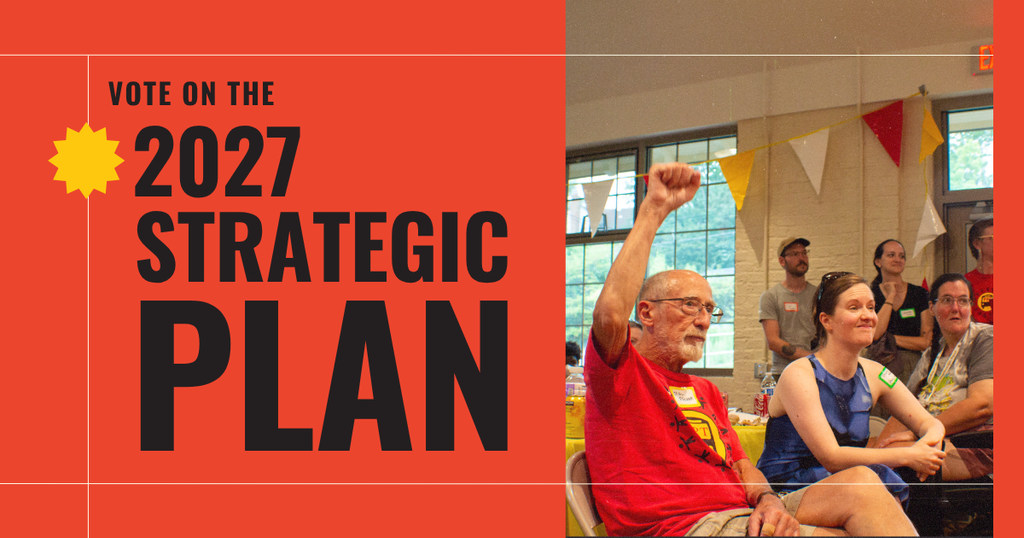
Image Description: PPT members raise fists and smile at the 2026 Summer Party
Pittsburghers for Public Transit is your riders’ union, and every year, its strategic plan is co-created by members like you.
You have the power to help decide what campaigns PPT takes on in 2027. Your vote matters: Cast your vote by Wednesday, November 11th!
How voting works
The Strategic Plan lays out a clear set of organizational development and campaign goals that guide members’ and staff’s organizing, research, and communications work for the coming year.
In each Strategic Plan, there are 5 “buckets” of thematically connected campaign work:
- Fair Fares
- Equitable Infrastructure
- Reliable and Expanded Service
- Fund Transit for All PA
- #VoteTransit
Within each bucket, there are many campaigns that PPT could take on. That’s where your vote comes in.
PPT members vote on the Strategic Plan using ranked choice voting. You can rank each possible campaign based on how important you think it is for PPT to prioritize. Ranking something first means you think it should be first priority.
After all the votes are in, PPT board and members will have the chance to ratify the top vote-earning campaign goals in each bucket.
In addition to these campaign goals, the Strategic Plan also contains a set of internal Organizational Development goals, which will not be up for a vote. These goals represent our programmatic commitments to develop strong, engaged, and connected leaders; to resource the movement through membership and by organizing philanthropy; and to advance accessibility for all.
Campaign Goals
Below, you can read more about each bucket of campaign goals. You can also head straight to the voting form, where the goals and additional context are written out.
PPT/T4APA advances freedom of movement by tackling transit barriers and advancing visionary solutions for affordable fares, equitable infrastructure, for reliable, expanded service, and for robust and sustainable public transit funding. We also recognize the need to cultivate legislators as transit champions through electoral education and by shifting the public narrative on transit.
Our five campaign buckets identify the scope of PPT/T4APA’s organizing, the visionary outcomes that we are working towards, and the specific and measurable progress that we will achieve this year. PPT/T4APA members and leadership will vote on the goals that the organization will focus on in 2027:
Fair Fares
No rider should be unable to access transit due to fares. In fact, fare programs should be used to grow transit ridership by making it seamless and cost-effective to ride. The PPT Transit Bill of Rights particularly lays out the need for equitable distribution of public transit costs, with corporations paying their fair share.
The high cost of fares, the legibility of transit fare payment programs, and criminalized transit fare enforcement policies are barriers for the availability and safety of transit usage for all communities.
Under the “#FairFares” campaign, we advance affordable and sponsored fare programs like Allegheny Go and the PRTner pass, organize for clear and accessible fare payment mechanisms, and push for decriminalized fare enforcement supported by civilian fare ambassadors. Under this campaign bucket, we can organize in 2027 for:
- The transition to zero fares for Allegheny Go.
- The passage of Transit Demand Management (TDM) legislation at the City/County. This would require businesses to offset their employee or tenant car congestion and emissions by buying transit passes, or by building quality bus shelters and sidewalks.
- Countywide free transit service on Election Day, sponsored by a corporation or paid for by a County fund.
- Fare capping with the ReadyFare payment transition. Fare capping limits the total amount a rider is charged over a specific period (like a day or a month) by automatically converting single-ride payments into the equivalent of a daily or monthly pass once a spending threshold is met.
- The purchase of the PRTner pass (free transit passes) for Housing Authority tenants and Allegheny County employees.
Secure Equitable Infrastructure
All communities must have street and housing infrastructure to support safe, efficient, accessible and dignified access to public transit for riders. The PPT Transit Bill of Rights states that we have a right to safe, reliable, environmentally-sustainable, and affordable transit that is accessible to all.
The availability of affordable and accessible housing by transit, connected and maintained sidewalks, bus shelters, and bus-only lanes determine whether public transit is a viable and preferable means of transportation.
Under the “Secure Equitable Infrastructure” campaign, we focus on the role that local and state governments play in building and maintaining streets, in housing development and in transit infrastructure. Moreover, we organize to ensure that municipalities keep our public infrastructure public- to stop the privatization and monetization of our streets through private transportation technology. Under this campaign bucket, we can organize in 2027 to:
- Increase funding for transit amenities in the city budget.
- Audit and identify new sidewalk and bus shelter deployment opportunities in the City of Pittsburgh.
- Win a maintenance & enforcement plan to improve transit access. This would include organizing around snow removal at sidewalks and stops, and around the enforcement of no parking policies on sidewalks and in front of bus stops.
- Win transit-oriented development policies.This goal would focus on the need for more affordable, accessible and dense housing by public transit, and to reduce costly parking requirements at quality public transit stations.
- Improve accessible infrastructure at PRT stations, buses and trains. This goal could focus on the need for more accessible seating on buses, accessible and multilingual signage and technology, and have us organize around access gaps in transit stops and stations.
Reliable and Expanded Service
Transit riders have a right to their time, and riding transit should not take longer than taking a car. To that end, we believe that all residents should have access to transit within walking distance of their homes, with service that comes reliably at a minimum frequency of every 30 minutes. The PPT Transit Bill of Rights states that we have a right to a public mass transit that meets the needs of each community, with no communities left out.
For public transit to be useful and usable, it must be available at the time of day or the day of the week that riders need it, connected to the destinations that they need to go, and scheduled frequently enough that riders can get to their destinations in a timely manner. Moreover, it must reliably arrive when it is scheduled, and the transit agency’s communication about both schedules and routing must be accurate.
Under the “Reliable and Expanded Service” campaign, we organize for transit service improvements to better meet riders needs around routing, service reliability, frequency and span, and to ensure that transit service information is accurately communicated to riders. Under this campaign bucket, in 2027 we can organize around:
- The impact of the Busline Refresh plan on current riders.
- The need for improved service reliability, and for accurate and reasonable scheduling for the routes.
- The need for improved PRT communications. This goal would organize riders to demand transit schedules that have more timepoints, accurate and consistent information communicated between apps, the printed schedule and bus stops, and clear information about upcoming changes.
Fund Transit for All PA
All communities deserve sufficient public funding to provide quality, affordable, and expansive public transit. The PPT Transit Bill of Rights states that we have a right to dedicated and sustainable funding to mass transit.
When local, state and federal funding for public transit is inadequate, our neighbors, our economy, our climate and our communities’ public health suffers.
Under our “Fund Transit for All” campaign, we organize for more funding for transit at all levels, to activate new progressive taxation mechanisms, and to ensure the equitable allocation of transit funding for all communities to meet each region’s diverse needs. Under this campaign bucket, in 2027 we can organize to:
- Establish new, recurring, dedicated money for public transit sufficient to restore and expand service, in the face of threatened, catastrophic service cuts and fare increases for all transit agencies in PA.
- Win a new process for funding paratransit and shared-ride transit, so that disabled and older adult transit riders in small and rural communities have reliable and growing access to these point-to-point lifeline transit services.
- Win a more equitable agency-by-agency split of state public transit funding in PA, so that each community receives money from the Public Transit Trust Fund based on their needs, and the cost to deliver reliable service.
- Win legislation that would require PENNDOT to prioritize equitable, efficient capital projects in transportation. This would ensure that PENNDOT funds projects based on criteria like economic benefit, climate impact, traffic congestion, and # of users compared to cost. In other states, similar legislation has helped grow the amount of state funding for public transit projects.
- Enable new local funding sources in local governments for transit capital projects. This would allow local governments like Allegheny County to be able to run referenda or identify new taxes and fees that could fund transit infrastructure projects.
#VoteTransit
Elected officials at all levels should advance policies to provide public transit as a right, with the broad support of the voting public.
Decisions around affordable fares, equitable infrastructure, reliable and expanded service and transit funding are made by our elected officials at the local, state and federal levels. To win transformative change, we need to shift the public narrative around transit and elect transit champions at all levels. Under the “#VoteTransit” campaign, we develop and amplify effective narratives to broaden public support for transit, educate transit riders and candidates for elected positions on the issues and solutions we want to see, and hold elected officials accountable at the ballot box and beyond towards expanding transit access.
Importantly, Pittsburgh City Council is responsible for decisions affecting transit riders around land use, zoning, and affordable housing; infrastructure projects like sidewalks, bus shelters, and bus lanes, City department staffing and employee policies, and City budgets. The Allegheny County Executive has authority around Pittsburgh Regional Transit (PRT) board appointments, direct supervision of the PRT CEO, the County budget line items funding PRT and low-income fare program Allegheny Go, and broad oversight over agencies including Pittsburgh Regional Transit, the County Department of Human Services and Allegheny County Economic Development.
Under this campaign bucket, we can organize around:
- Pgh City Council District 1 election, currently held by Councilman Bobby Wilson.
- Pgh City Council District 3 election, currently held by Councilman Bob Charland.
- Pgh City Council District 5 election, currently held by Councilwoman Barb Warwick.
- Pgh City Council District 7 election, currently held by Councilwoman Deb Gross.
- Allegheny County Executive election, currently held by County Executive Sara Innamorato.
Remember, PPT members are eligible to vote by Wednesday, November 11th!
Organizational Development Goals
Winning visionary change for public transit requires a steady and tangible plan to sustain, grow, and skill up our base of transit riders and workers. PPT/T4APA’s Organizational Development goals lay out our programmatic commitments to develop strong, engaged and connected leaders; to resource the movement through membership and by organizing philanthropy; and to advance accessibility for all.
The following Organizational Development goals are not up for a vote, but are written below for your knowledge.
Develop strong, engaged, and connected leaders
- Host regular Organizing, Communications and Research Committees to share and practice skills to advance our campaign goals.
- Develop a Westmoreland County Transit Organizing Hub through a Regional Fellowship Program.
- Support continued organizing in past fellowship locations serving LANTA, Red Rose Transit, LCTA, and COLTS riders and workers.
- Recruit and train Bus Captains to build organizing structure and connections with riders and workers on their routes.
- Host a Transit for All PA Harrisburg Day of Action to skill up rider leaders in the fight for state transit funding.
- Support member celebration and connection with Summer and Winter Parties.
Resource the Movement by Growing Dues-Paying Membership and by Organizing Philanthropy
- Run Summer and Winter membership drives
- Begin a donor program that opens an additional pathway for supporters to financially resource the organizing
- Secure foundation funding
- Develop a Transit for All PA membership program
Advance Accessibility for All: Disability, Language, and Community Care
- Adopt the PPT/Transit for All PA Code of Conduct
- Compile resources to connect members to mutual aid programs and other basic needs