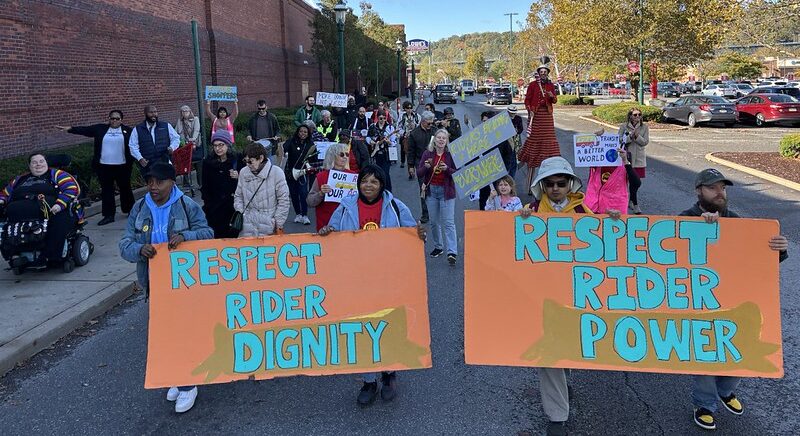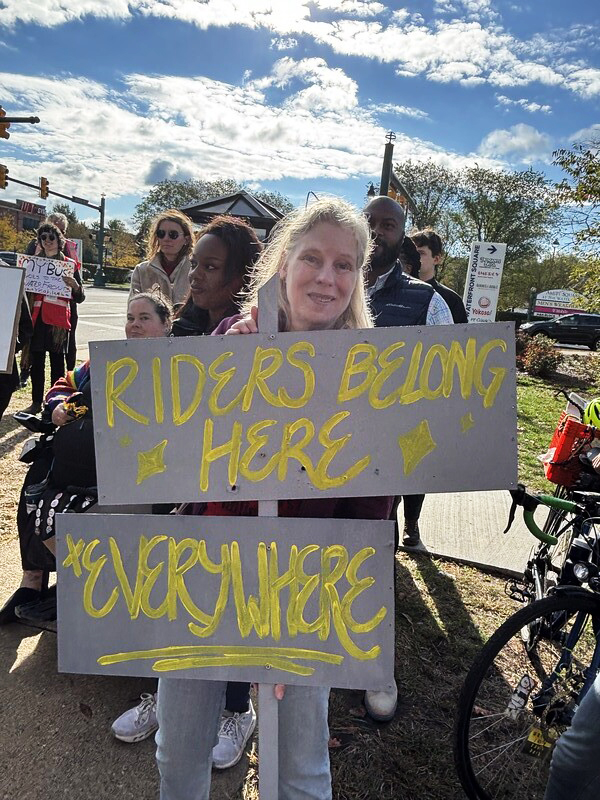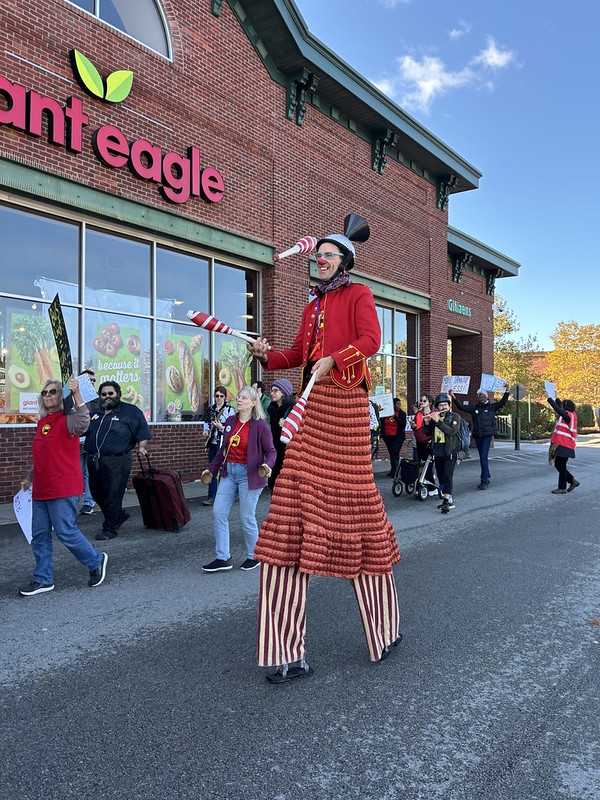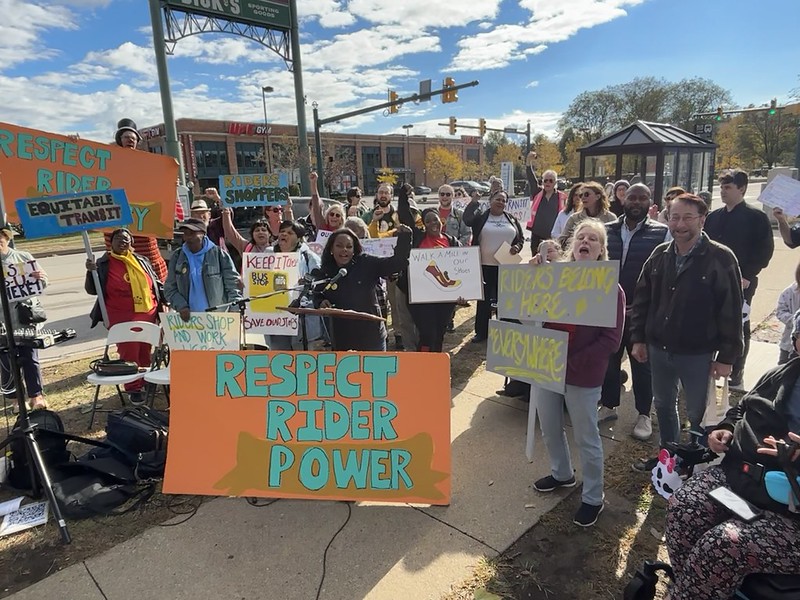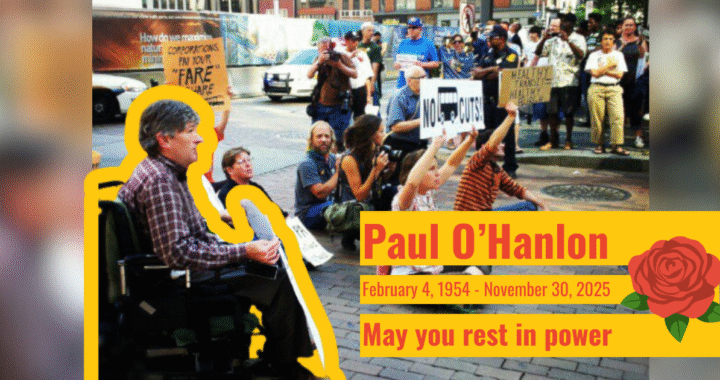
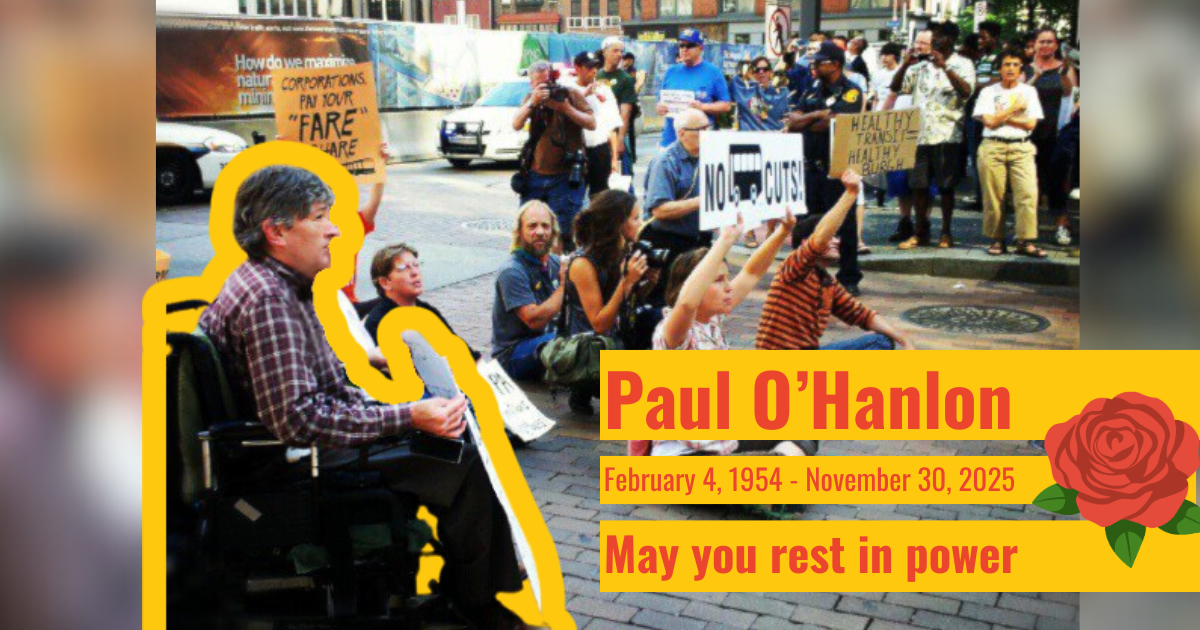
Our PPT family mourns the recent passing of Paul O’Hanlon, Board member and co-founder. His spirit will live in our organizing forever.
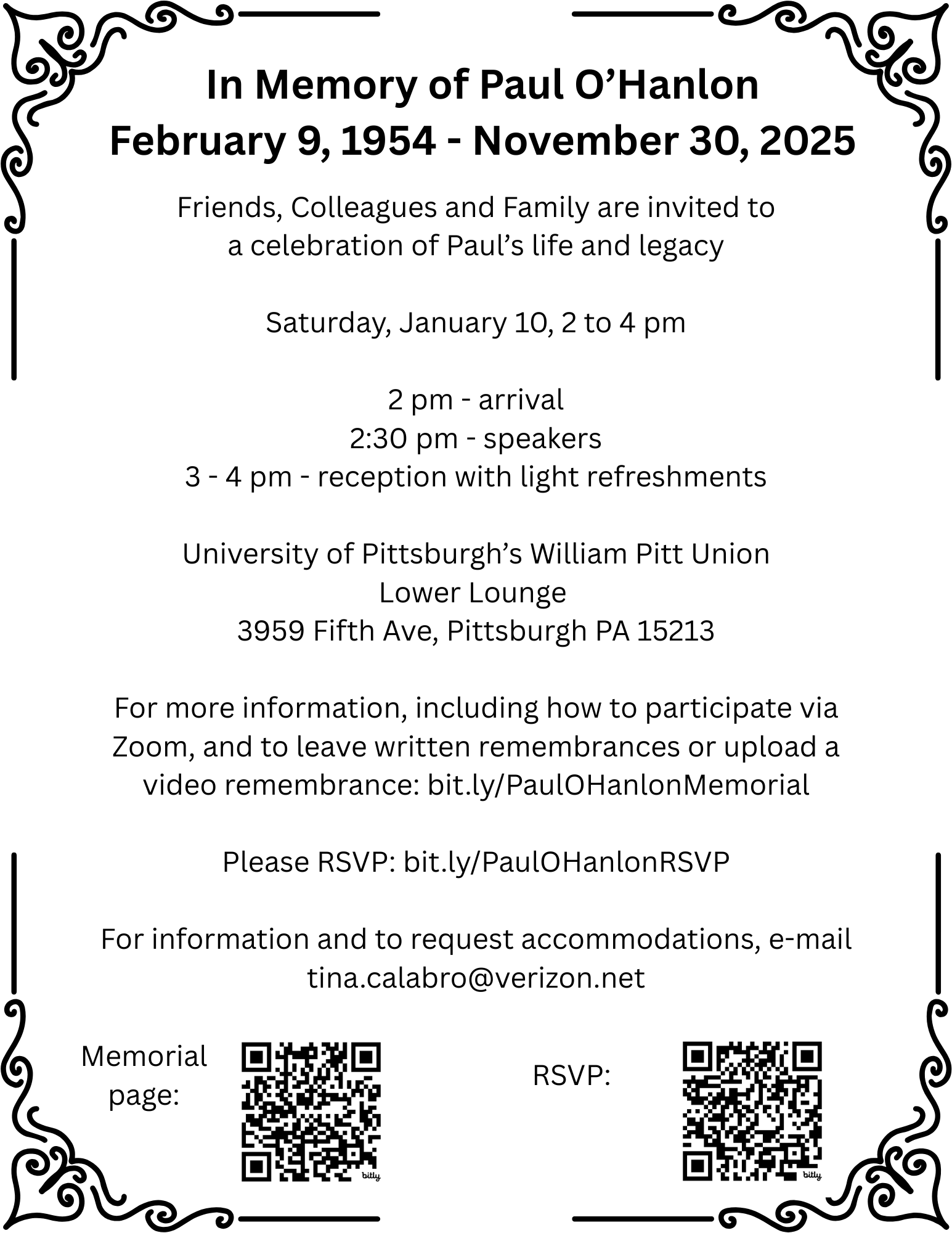
Paul O’Hanlon Memorial Service
Saturday, January 10th, 2-4pm
University of Pittsburgh’s William Pitt Union, Lower Lounge
3959 Fifth Ave. Pittsburgh, PA 15213
Friends, Colleagues and Family are invited to a celebration of Paul’s life and legacy.
2pm – Arrival
2:30pm – Speakers
3 – 4pm – Reception with light refreshments
Parking is available at Soldiers and Sailors Memorial or Carnegie Museum. Nearby bus routes include the 54, 61A, 61B, 61C, 61D, 67, 69, 71A, 71B, 71C, 71D, 75, 93, and P3.
For more information or to request accommodations, please email tina.calabro@verizon.net
Pittsburghers for Public Transit was founded with the fire of Paul O’Hanlon and the community that he inspired. Over the years, he helped this movement grow with his ideas, humor, and an unwavering sense of justice. He joined us in the protests, and he joined us at the parties. He taught us how to fight and love. His spirit will live in our organizing forever.
Paul was a powerful organizer for human rights, with a clear understanding of how our movements for disability justice, transit justice, housing justice and voting rights are connected and necessary. He was courageous, smart, committed and supportive, and he has mentored so many in bringing their power to the light.
We will miss Paul deeply, and we offer all of PPT’s love and community to his family in this difficult time.
Rest in power, Paul. Your memory will fuel our fight until every person can access the opportunity they deserve.
- Paul’s obituary
- RSVP to Paul’s Memorial Service on 1/10 [flyer here]
- Leave a video memorial message for Paul – to be shared during his memorial service
- Leave a written memorial message for Paul – to be shared on this page
- Photos from Paul’s 2012 civil disobedience & arrest with the Transit Twelve calling for increased public transit access for all
- Paul’s family invites you to give a membership donation to PPT in his honor
The PPT family is invited to leave your words of remembrance here, or record a video of yourself sharing your words of remembrance and upload it here. All written and video remembrances will be added to this page. Please note that we are also putting together a video presentation for the public memorial honoring Paul’s work in the field. Excerpts from our recordings will be used!
Read remembrances from PPT Members:
Dean Mougianis
It’s a cloudy Pittsburgh day in 2011 and I am on a bicycle in the back alleys of the strip district. I’m panting and wheezing, pedaling as fast as I can, dodging potholes that I hope won’t upend me. Partly, this is because I’m running late, trying to get to a protest of Governor Tom Corbett’s education cuts. But mostly, it’s because I am trying my damnedest to keep up with Paul O’Hanlon, who is making his motorized wheelchair bounce and rattle atop the broken pavement at a dizzying speed. We were both at a meeting of Occupy Pittsburgh, and I had decided I should accompany Paul on the trip. You know, look after him a bit. Silly me. He’s leaving me far behind and it’s all I can do to try to match his pace.
I think that’s all any of us could ever do. Try our feeble best to keep up with him.
I first met Paul on election day in 2008, in the “escalation room” of Election Protection – lawyers who volunteer their services to safeguard our vote. I was there as the dispatcher for “Video the Vote” a group trying to do the same thing with video cameras. (This was before everybody had cellphone cameras in their pockets.) There were a few dozen attorneys around a big conference table at a downtown law firm. They took calls from an 800 number. If the call seemed like it represented serious skullduggery, then it was escalated to a smaller group of more expert lawyers. Alpha lawyers you might say. Paul was without doubt an alpha lawyer, and so there he was – ready to battle electoral evil.
Mercifully, there was less skullduggery than anticipated that election. That left a lot of down time to sit and talk and get to know the person working next to you. The Paul I got to know that day was passionate, whip-smart, warm and sincere. The kind of person who leaves an impression on you – a serious Atticus Finch vibe.
As I indicated, our paths crossed again in the muddy confines of the Occupy Pittsburgh encampment. Well, actually, just before. He was there at a planning meeting, laying out the legal case for taking over the public space of Mellon Green downtown. When it came to Occupy, Paul seemed to be everywhere. Dispensing legal information, yes. But more importantly, movement wisdom. Paul had seen a lot advocating for disability rights, housing rights, education rights, etc and learned from every bit of it.
It was in the area of public transit where I came to know, and appreciate, Paul the most. He was part of the founding group of Pittsburghers for Public Transit. That same year of 2011 transit in Pittsburgh was facing a 40% cut. Cuts had been foisted on the public for years and this one would be devastating. Paul understood, along with others, that the public needed to be aware of a trend that was happening in darkness. And thus the Transit Twelve was born – a dozen activists who sat mid-road and stopped traffic in downtown Pittsburgh to raise awareness of the damage those cuts would do.
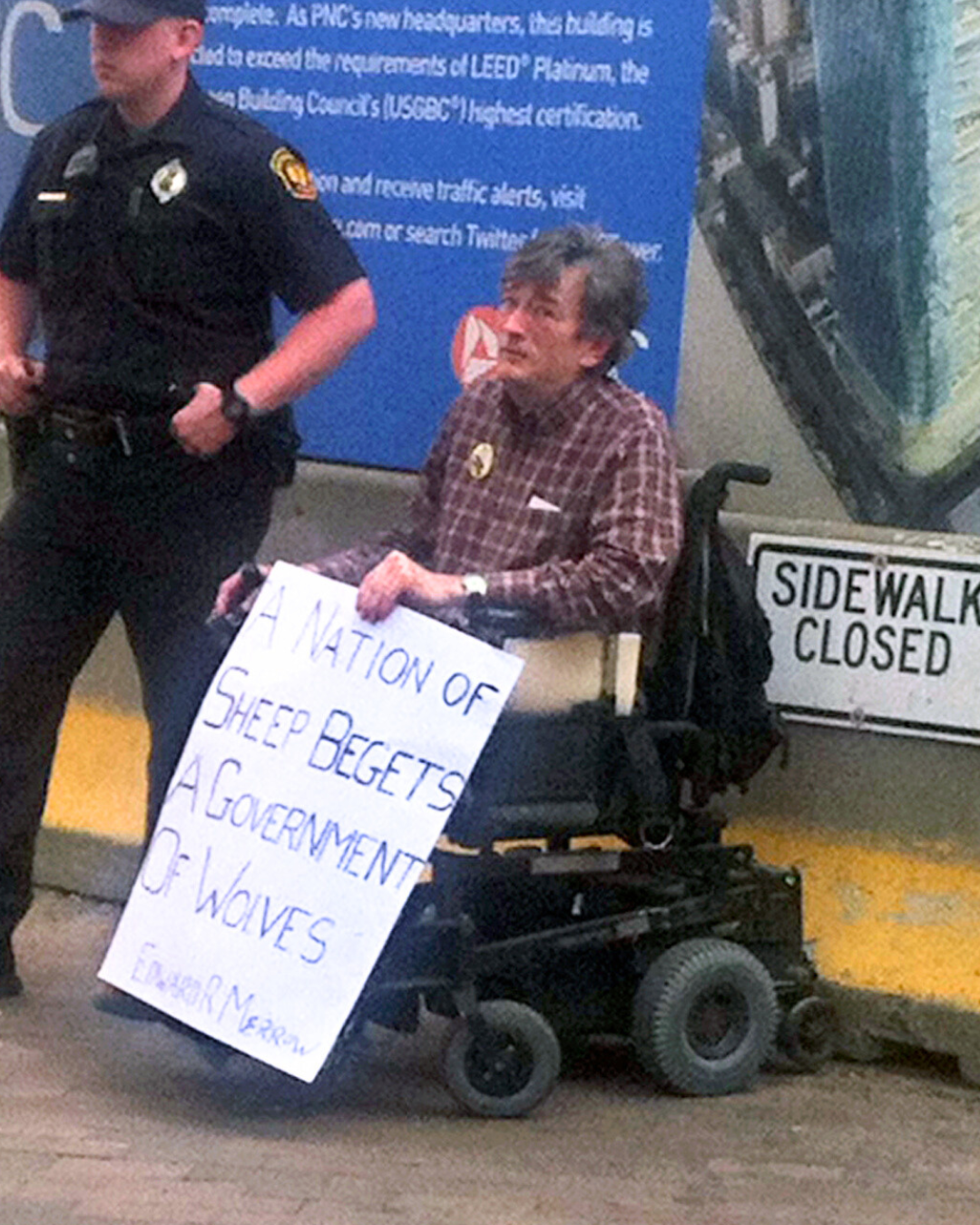
The Twelve were arrested for their civil disobedience and carted off to be arraigned of course. Well, eleven of them. The police did not know what do to with the erudite and self-assured attorney in the wheelchair. They couldn’t just toss him in a squad car. The picture you see above is of Paul next to a police officer – a Paul miffed because he isn’t being arrested along with the others. The story I heard is that shortly after this picture was taken, Paul got impatient and just motored over in his chair to the public safety building, driving himself to his own arrest. I haven’t been able to confirm the story’s veracity – but it’s true to the Paul that I knew. That’s exactly the kind of thing he would have done.
Paul was on Pittsburghers for Public Transit’s coordinating committee (the precursor to the board of directors) for years. I watched him consistently guide legal and organizing policy with his careful and wise counsel. He was everything a great movement lawyer should be – thorough, precise, compassionate. And with all that brainpower, with all that experience, I never once saw him be condescending or less than completely open to the contribution of others. As is true with such a long list of issues – transit in Pittsburgh would be severely diminished without the efforts of Paul O’Hanlon.
Earlier this year, Paul had a medical setback that sent him to the hospital. The condition made it difficult for him to speak and even breathe. When I went to visit, he wanted so badly to hear about what everyone was doing in the movement space. And he had a take on all of it, spoken in his same measured and complete way, even though he struggled with every word. Because he labored so hard to speak, it was all I could do to stop myself from trying to finish his sentences. Paul, though, was going to say it the way he felt it should be said – no matter what that took.
Amazingly he bounced back from it. There he was out in the world again, buzzing around in his chair, making sure he didn’t miss anything. Sadly, so very sadly, that was short-lived. Last week illness and infection caught up to him. As quick and as mobile as he was, mortality still caught up to him – in the way it will overtake all of us. He passed away last weekend. This passing hits me hard, as it hits dozens, maybe hundreds, of others.
I’m going to conclude with a quote I think Paul would have approved of. It’s from Mother Jones, who said:
“Pray for the dead and fight like hell for the living”
I will miss you – my comrade, my friend.
Alisa Grishman
When I was 14 years old, my dad had a conference in Denmark, and I tagged along. It wasn’t safe to let naive little me wander the streets of Copenhagen by myself, though. Thankfully Lori Levin brought her husband, Paul O’Hanlon, and their 10-month-old son Sam along with her. My dad somehow conspired with them that I thought that I was being Daddy’s Helper by pushing Paul around town in his manual wheelchair and playing with Sam in various playgrounds, when really Paul was babysitting me.
A few years later when I’d moved to Pittsburgh to attend Carnegie Mellon, I ran into Paul. He remembered me and we exchanged some pleasantries, and then I didn’t really see him again for about a decade.
In 2015, however, all of that changed. I’d become more and more disabled myself at that point, and after meeting my dearest, beloved friend Richard Meritzer, he brought me to my very first City-County Task Force on Disabilities and introduced me to such powerful voices as Jeff Parker, who I miss dearly. There with everyone else… was Paul. And Paul welcomed me with open arms.
The following year, I’d already started up Access Mob Pittsburgh and I was eager to prove myself and get involved in absofuckinglutely everything. Paul came to me and told me about his big project he’d been working on for many years, Pittsburgh Ballots for Patients, and asked if I would be interested in helping out. That was the first year I was in charge of volunteers for Ballots for Patients, and I’ve done so every two years since then. We had at our height (before UPMC decided to be helpful and provide some of their own aides) upwards of 70 volunteers in nine area hospitals collecting emergency absentee ballots from hospitalized patients who couldn’t go to the polls. This has been some of my proudest work.
There are so many other projects we worked on together as well. He got me involved with the Committee for Accessible Transportation, and we fought HARD to make them allow paratransit vehicles to pull over in bus lanes. We advocated loudly about the need to make the Department of Permits, Licensing, and Inspection prioritize accessible entrances when businesses were making ADA-related infrastructure improvements, to the point that we got a hearing with City Council and the City’s legal team to plea our case.
I cannot say that I agreed with Paul on everything. He could be super pig-headed and obstinate, especially at the end. We had an on-going dispute about whether or not it’s OK to force riders without mobility devices to get up for those who do (it absolutely isn’t – invisible disabilities are still real disabilities).
What I can say, though, is that I would not be the amazing human I am without Paul. And for that I will hold him close in my heart for the rest of my life. Thank you, Paul, for everything you’ve taught me, and for the strength you’ve given me. I promise to keep Ballots for Patients going, and to continue your legacy of advocacy in this City. I love you forever.
Cassandra Masters
Paul was one of the first people I met in 2019 when I worked for ACCESS paratransit. I learned from him trillions of things about disability justice and the abysmal transit access across the city and country for people with disabilities over the years.
Paul’s advocacy radicalized me in so many ways (and we didn’t even know each other that well!). I specifically remember talking with him about how sidewalk curb cuts, while essential, *cannot* be the only accessibility win we fight for–neighbors deserve curb cuts AND we have to dream bigger. I think about it every time I see a new curb cut. He leaves behind a remarkable legacy. Rest in power, Paul.
Andrew Hussein
Alas I can’t exactly remember when I 1st met Paul, it’s been a wild and rough last few years. What I can say is I definitely remember Paul being very insightful, inspirational and a fierce fighter and both Pittsburgh and the PPT Community are a little bleaker with this great loss! The remembrance at the top of the PPT Blog says it well, May you rest in power, friend!
Laura Chu Wiens
A few years ago, the members and staff of Pittsburghers for Public Transit thought up a slogan that would encapsulate our work for the year. It was: “This Bus is for All of Us.” The artist whom we enlisted to make the poster came around to get inspiration for what they would draw that reflected our community. What emerged at the front of the poster, smiling and ready to board the bus, was an illustration of Paul, because transit was a joy to him, and because he has always been a transit advocacy leader.
PPT, though we can now boast being around for 16 years, was hardly the first organizing home for Paul around transit. I remember Paul sharing his experience travelling around the City and County in 1991 just after the passage of the ADA. At the time, only a handful of buses had wheelchair ramps installed, and they ran on only one or two routes. That was revelatory to me- what it meant for movement, for one’s ability to live if you were a wheelchair user who was limited to one or two accessible corridors in the County, or before that- none at all.
Public transit was to become a gateway to freedom for people with disabilities- through the relentless advocacy of Paul and John Tague and others who went on to bottom-line the newly organized City County Taskforce on Disabilities.
But I think about how back in 1991, 35 years ago, Paul could only travel on a single, solitary route- and yet could envision a transit system in which the whole County would be accessible. We saw Paul going on to demand it. That awes me: who else among us has such clairvoyance, such determination and such hope?
Paul was the best kind of stubborn, clear minded about the obstacles to surviving, to participating, to thriving in this world, and refusing to let them stand. At the outset of his role with PPT, he blocked Fifth and Wood Street downtown to demand action and state funding for transit along with 11 other PPT members – and took an arrest for this civil disobedience. Or rather, he would have, but Pittsburgh police didn’t have a van that could accommodate his wheelchair and so turned him loose. Paul offered to roll to the jail himself, and they still refused. And so Paul went home on the bus, but as his spouse Lori describes it, he was so agitated that the others were in jail without him that he turned around, caught the next bus, and went right to the jail so that he could be together with the others in solidarity.
While this is an example of his courage, his activism was steady, strategic and long-term. Paul organized alongside community members up and down the Mon Valley to prevent the cuts to the 61 A,B,C buses in 2017, he was part of the braintrust of members that developed PPT’s Fair Fares platform in 2019. He called on PPT to join him in a lawsuit to compel ridehailing companies to provide accessible vehicles under the ADA in 2020. He guided our work for accessible stops and shelters, and around affordable housing, and against the proliferation of private transportation tech.
Paul recognized how our environment can be designed in ways that make our lives smaller and meaner- a single route with only one origin and one destination. But for all the injustice that he experienced, that he perceived directed to others, I never saw him organize with anger at the fore.
There are so many movement lessons here that Paul has given to me, and to us. We must hold and communicate joy in our organizing along with the frustration. We should be impatient for justice and also ready to fight for as long as it takes to win.
Transit can be a vehicle of our liberation, not a last resort. It can be a chauffeur, a valet, a palace for the people. It is our public good.
In organizing for freedom of movement- for people with disabilities – Paul was opening up the pathway to life for everyone. For low-income folks, for youth, for older adults, for undocumented immigrants- other communities that he was always lifting up alongside his own.
This Bus is for All of Us.
Any one of these organizing efforts would be impressive enough in its own right- but PPT was only one very small part of the legacy that he leaves behind. From founding Ballots for Patients, whose work continues through the leadership of Alisa Grishman and Access Mob, to organizing tenants and advocating for more expansive use of Section 8 homeownership opportunities, to participating in a commission for Wilkinsburg’s home rule charter, to laying the groundwork for so much of the disability rights gains in Southwest PA over the last half century, Paul O’Hanlon was somehow both the mildest and fiercest force to be reckoned with. He is survived by his spouse Lori and son Sam, and by all of us- we will continue the movement in his memory.
Ken Regal
Thankful for our friendship with Paul over many decades beginning when we were housemates in a (usually) cooperative house in the early 1980’s and continuing in work together for voting rights and other social justice issues. Paul was truly a hero who made our community a better place for everyone to live and thrive.
Donna Gates
My favorite story about Paul is when he presented an award to Port Authority management for adding buses with wheelchair lifts. At the time, the lifts rarely worked and Paul was trying to draw attention to the fact. So, he and others met Port Authority management downtown to present an award to them at a bus stop. Press was there. When an accessible bus pulled up for them to get on, the lift did not wotk. Port Authority managers were embarassed and assured everyone these would be fixed. Paul viewed the ability to ride a bus as a blow for freedom to be able to go where he wanted to go. These buses work now.
Amanda Clark
Paul had such a kind and giving heart. He onboarded me to Ballots for Patients, back before mail-in voting was a thing. He helped me with my illegally-held security deposit. I didn’t know him well, and won’t claim to, but he touched many hearts, and I was one of them, and I will always be grateful for that, and will always miss his presence in our lives now. I pray for peace and comfort to his family and friends, and I pray his spirit lives on in the rest of us.
Ron Gaydos
Whether knowing Paul at the Pittsburgh Quaker Community house on Homewood Ave, to seeing him assertively enter buses on his way around town, to standing up for people in his legal work, I’ve always admired him and looked forward to seeing him every time.
Dustin Gibson
Paul embraced me and the ideas that I had as a young activist. He showed up to everything he could. He supported while still offering suggestions based on his experience and critique. I can imagine he did that with countless people. Paul was clear about the connections between systems of oppression and worked to forge solidarity between different struggles. I appreciate how he worked to weave together different groups of people essentially fighting for the same things.
Anyone in the PPT community is welcome to leave your words of remembrance below, and they’ll be added to this page:
Here are some prompts to guide your message:
- “My favorite story about Paul O’Hanlon is . . . “
- “I would like to thank/acknowledge Paul for the work he did with . . . “
- “The thing that always struck me about Paul is the way he . . . “
- “I will always remember Paul for . . . “