Outline of this blog:
- You Gotta Take a Look at This: Pittsburgh Regional Transit’s Busline Redesign Refresh
- Pittsburgh Regional Transit Needs to Get its House in Order Before Overhauling the System
- Pittsburgh Regional Transit Doesn’t Have to Wait to Implement Common-Sense Improvements
You Gotta Take a Look at This: Pittsburgh Regional Transit’s Busline Redesign Refresh
Two weeks ago, Pittsburgh Regional Transit dropped their “Busline Refresh” Draft 2.0, a proposed redrawing of our transit system’s bus network. This will have major impacts on our entire region – not only on transit riders and transit workers yes, but also our schools, healthcare providers, employers, our road congestion and our county’s economy. It is very important that everyone carefully review and give feedback on Pittsburgh Regional Transit’s Busline Refresh online or at their upcoming meetings. Pittsburghers for Public Transit participatory research committee will be spending the next few weeks evaluating the proposal route-by-route. We’ll also be hosting Pittsburgh Regional Transit to review and discuss the draft plan in our April monthly meeting-you should join us there too!
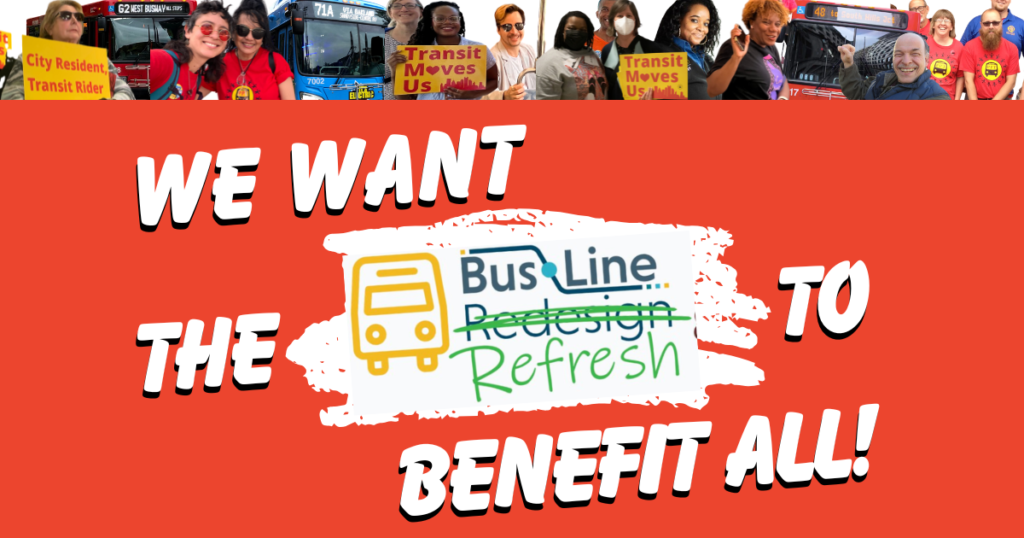
Public Feedback Matters: Riders Spoke Up about Busline Redesign Draft 1.0 and Pittsburgh Regional Transit listened to a lot. Over the past year, transit riders and workers have been organizing to improve the Busline Redesign and make it more of a Busline Refresh. Together, we called we called for a Bus Line Redesign that Benefits All. In our 2025 report, A Roadmap to a Busline Redesign for All, we told the agency to scale back the proposed disruption to our routes – most importantly, not to fix what’s not broken. We also called on the Agency to provide riders with a commute “calculator” so that we could model the proposed changes to our trips, and to ensure that the proposed “microtransit zone” communities like McKeesport, the Southern Hilltop and Natrona Heights are provided with expanded fixed route buses, not irregular on-demand shuttles. Riders and workers drove this message home with a petition that garnered more than 1,000 signatures, and a rally held on a cold and rainy January morning before delivering public feedback at the transit agency’s board meeting.
To PRT’s credit, they heard you, and have incorporated this feedback in the new proposal. There’s still a lot to review, however, and we expect that there will be both gems and concerns about this Draft 2.0.
Pittsburgh Regional Transit Needs to Get Its House in Order Before Overhauling the System
Even the Best Service Plan Won’t Succeed if There’s No Money for Implementing It
It is currently almost inconceivable that politicians in Harrisburg will pass a dedicated, long-term transit funding bill by 2027, the proposed implementation date for the Busline Refresh. The last time Pittsburgh Regional Transit did a Busline Redesign (the Transit Development Plan, also known as Connect ‘09), it was aborted in the middle because of a transit funding fiscal cliff.
At that time, new routes that had just started were rolled back, and others were never implemented. In fact, Pittsburgh Regional Transit had to cut 15% of overall transit service due to a lack of dedicated, expanded state funding (eliminating 29 routes, reducing 37 routes, and closing a bus garage). Riders cannot be asked to endure major service changes only to have them abandoned halfway through the process.
Frankly, even just stable funding is not good enough- the resources should be in place to reverse our cuts.
We need more than this status quo. Our transit service is now beyond austere. Allegheny County currently has the lowest levels of transit service since the first half of the 20th century. Implementing this “cost-neutral redesign” will lock in the 20% service cuts we’ve experienced just in the last five years of the pandemic, and the nearly 40% cuts we’ve endured over the last 20 years.
With a cost-neutral redesign, Pittsburgh Regional Transit is shuffling deck chairs on the sinking Titanic and forcing unconscionable choices about which community will get more transit service at the expense of others, when all communities need and deserve more.
It’s Not Just the Funding- Pittsburgh Regional Transit Needs to Grow Ridership, Improve Reliability and its Communications Before Upending the System
Pittsburgh Regional Transit must significantly grow ridership and improve service reliability before implementing the entirety of the Busline Refresh. Major bus changes, no matter how positive those changes are, will cause ridership loss at the outset. The Agency cannot afford to upend our bus system and lose more riders when it is starting at such a deficit.
PRT’s ridership has declined the last two years in a row, to 59% of pre-pandemic ridership. By contrast, transit agencies nationwide have restored ridership to between 75%-85% of 2019 levels and are seeing ridership growth every year; PRT’s ridership recovery places them 136th out of 150 U.S. transit agencies (in the bottom 10%!) for restoration of ridership since the pandemic started.
There is no shortage of ways that Pittsburgh Regional Transit can meaningfully grow ridership now – even under its current fiscal constraints. They can start by becoming unabashed champions of their new fare programs (Allegheny Go and the PRTner pass) which will make it cheaper and easier for more riders to access the bus. They can also restore the 71 and 61 bus lines to Downtown which resulted in huge ridership loss, and they can capitalize on the massive influx of visitors for the NFL Draft and other huge events this year.
Moreover, until Pittsburgh Regional Transit can run its existing service effectively and reliably, riders have little faith that a wholly-redesigned bus system schedule can be successfully implemented.
In PRT’s 2025 annual service report, it showed that PRT’s bus system on-time performance hovers at 66%. That means that 1 in every 3 buses do not show up when expected. Riders need to trust that they can get to their jobs, their doctors’ appointments, their schools and childcare facilities on time and reliably through transit.
PRT can improve schedule reliability principally by writing more realistic schedules. Riders and transit workers have been calling on the agency to write more realistic schedules for years (see our 2022 report, Representing our Routes). PRT’s routes have been largely the same for generations, and every day the agency acquires more real-time data about how much time it takes for operators to drive these routes. All of this information should ensure that their schedule reliability and that their on-time performance gets closer to 100%.
Also, Pittsburgh Regional Transit must improve their communications around schedule changes. Even with much smaller changes than the Busline Redesign, riders are very frequently left stranded because of inaccurate information on bus stops or the printed schedule, on their website’s service change notices and even what is communicated to the operators around routing. Over the past year, that was a common refrain around the Downtown and Oakland construction detours, and even around regularly scheduled service adjustments. Pittsburgh Regional Transit’s rider communications around transit schedule and stop changes must be on point before they execute a system-wide change of this scale that will upend service frequencies and span, route names, and bus stop locations.
Pittsburgh Regional Transit Doesn’t Have to Wait to Implement Common-Sense Improvements
Finally, the smaller, good elements of the plan – adding service frequency, modifying existing routings- that can be implemented during a regular upcoming service change, should. Riders should not have to wait years for service improvements that will grow ridership, alleviate overcrowding or improve service reliability.
The agency already has the ability to change service frequencies and completely change bus routing during the thrice-yearly schedule changes. If anything, Pittsburgh Regional Transit is already overzealous in changing schedules (sometimes for more than 50 routes) in a “regular service change.” Nothing inhibits PRT from making critical adjustments or improvements to the bus routes and schedules immediately.
Other aspects of the Busline Refresh plan, including rebranding (PAT and Port Authority of Allegheny County, anyone?) and the relocation and elimination of bus stops (see our article from 2019!) are obviously already within their power to implement anytime.
We agree that change is needed: we have organized transit riders and workers for years to ensure that our transit system makes needed changes to address its concurrent ridership, service reliability, and funding crises. We have put forward solutions around service improvements and fare strategies that would grow ridership and revenue in our current funding “status quo” environment, and authored reports around service reliability that highlight schedule reliability issues so that they can be fixed.
The Busline Refresh is an important opportunity for transit riders and workers to weigh in on our bus network in the future. But while we weigh in on this plan, Pittsburgh Regional Transit must address its concurrent funding, ridership and reliability crises so that a good “refreshed” bus network builds upon a stable and resilient foundation.