Explore how the bus line refresh affects your transit

Explore How the Bus Line Refresh Could Affect Your Commute

The Bus Line Refresh could be the biggest service change in a generation. Your chance to make it better is right now! Learn how the proposals could impact you—and tell PRT how you feel about it. 

Explore the service changes that affect you

There are many ways to explore the changes PRT is proposing under the Bus Line Refresh. You can: 

After you do any of these options, it’s critical that you submit a public comment telling PRT how these changes would affect you. They need to know your thoughts in order to incorporate them into the proposal!

How to model your journeys on the Transit App

Note that this method requires access to a mobile device, like a smartphone. If you don’t have access to one, we recommend using the other tools listed above to explore the proposed Bus Line Refresh. 

  1. Download the Transit App to your mobile device. The app is available on both iPhone and Android. (Bonus: the app can be used to plan your future transit trips, and can even give you notifications when service changes or advocacy opportunities are available!) 
  2. You may need to make an account to use the app. 
  3. In the app’s main screen, type a destination in the “Where to?” bar. Select it from the list of results when it appears.
  4. Once you’ve selected your destination, you can also edit your starting location—for example, you might want to understand how your commute from your workplace to your doctor’s office might change.
  5. In the white portion of the screen, you’ll see a selection of potential routes you could take to reach your destination.
    The trips at the top are those you could take under the current PRT system.
    If you scroll down below these, you’ll see a section titled “PRT Preview Mode”, with potential future routes listed. 
  6. Click on a future route you’d like to explore. The app will then show you a map of the route, with details on how long the trip would take you, as well as scheduled frequencies and stops. 
  7. At the bottom of this window, there is a banner with a button titled “Give feedback”. This will take you to PRT’s feedback page for the entire Bus Line Refresh project. 
  8. When you’re done exploring this route, be sure to press the red “X” button at the top right of the screen to exit preview mode. 

Don’t miss your chance to shape the bus network

If you or someone you know takes transit frequently, PRT needs to know your thoughts. There are a lot of ways to give feedback on the proposed Bus Line Refresh: 

And of course, the best way (because it comes with community):

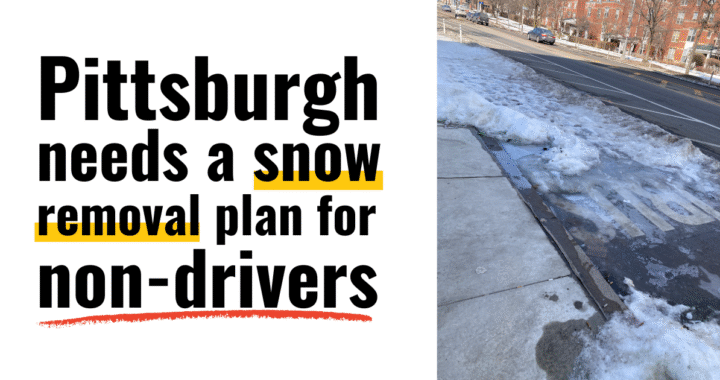
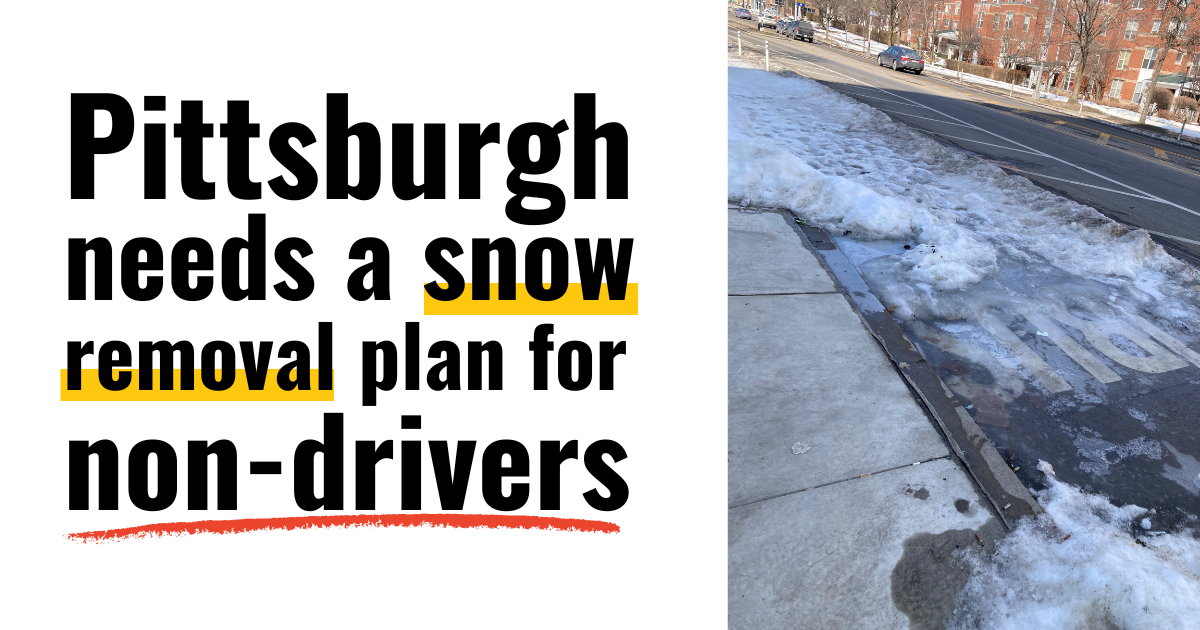
Tell the City of Pittsburgh: We Need A Snow Removal Plan for Non-Drivers

Image Description: an image of a Pittsburgh bus lane covered in ice and snow, next to bold black text reading “Pittsburgh needs a snow removal plan for non-drivers”.

This post was written by Alisa Grishman, Founder of Access Mob Pittsburgh, with support from Pittsburghers for Public Transit, Pittsburgh Center for Disability Justice, and BikePGH.

Even in snow, all Pittsburghers deserve the freedom to move.

On January, 25th, 2026, the City of Pittsburgh experienced a significant snowstorm. Since that event, our region has had persistently below-freezing temperatures- ensuring that unplowed, unshoveled snow remained where it fell for more than two weeks. Throughout this time, snow and ice have obstructed key sidewalk corridors, piled up in front of bus stops, and rendered curb cuts on street corners entirely inaccessible.

For the 30% of Pittsburghers who are non-drivers, the snowstorm and the City’s resulting inaction has been a prolonged disaster. 

Thousands of residents have been stranded, unable to leave their homes and safely access their grocery stores, medical appointments, schools and jobs. And people with disabilities have been disproportionately harmed by this failure to properly address snow conditions because there has simply been no accessible way to navigate our City’s right of ways under these conditions. Those who did venture out were forced to walk or roll on the street alongside active traffic, putting themselves into danger in order to access their daily needs. 

Our City’s lack of a pedestrian snow removal plan has become very apparent through this experience. 

The City failed to enforce statutes requiring property owners to shovel their sidewalks. Bus stops remain uncleared even two weeks later, and snow plows focused on clearing streets for single occupancy vehicles without regard to buses’ access to the curb. Worse of all, snow plows throughout the City used ADA curb ramps and sidewalks as storage space for large piles of ice and snow. 

How can the City keep our rights-of-way accessible to all after snowfall?

Access Mob, Pittsburghers for Public Transit, Pittsburgh Center for Disability Justice and BikePGH recommend that the City of Pittsburgh Develop a Pedestrian Snow Preparedness Plan. This plan must do the following:

  • Set clear roles within the City and County as to who is responsible for different aspects of snow removal. At present, the Department of Public Works is responsible for streets, and the Department of Mobility and Infrastructure cites property owners for failure to shovel sidewalks. There must be a specific agency charged with overseeing pedestrian right-of-way snow clearing efforts.
  • Support the passage of Councilwoman Barb Warwick’s legislation for a Right-of-Way Accessibility Needs Inventory.
  • Partner with Pittsburgh Regional Transit to identify and ensure clearing of high volume bus stops, stops serving critical infrastructure such as hospitals, schools, and grocery stores, and stops with frequent ramp deployments.
  • Formalize a relationship between the City and the County for collaborating around snow removal in pedestrian thoroughfares in the event of an extreme weather emergency.
  • Prohibit plowing snow onto curb cuts at crosswalks.
  • Update snow removal procedures at bus stops. Require roads and sidewalks at bus stops be cleared to the curb.
  • Ensure that walking routes to our public schools are clear and usable for the students and parents who are required to walk.
  • Ensure sidewalks on bridges are clear, which may involve creating maintenance agreements with adjacent municipalities.
  • Create a program that would incentivize residents to go out into their communities and remove snow in vital locations such as curb ramps and bus stops. (In New York City, the Department of Sanitation has an ongoing program wherein residents can apply to be an Emergency Snow Shoveler. In the event of a heavy snowfall, this network can be activated and shovelers are paid $19.14/hour to shovel out curb ramps, crosswalks, bus stops, and fire hydrants. On February 4, 2026, Philadelphia announced that it, too, would be implementing a similar program focusing on curb ramps throughout the city.)
  • Promote the Snow Angels program and incentivize participation.
  • Develop a media package (social, print, and televised) to educate property owners on their responsibilities in regards to snow removal, emphasizing why it is so important to do it properly.

We urge City and County leaders to treat this moment with the seriousness it demands and to act now in preparation for future moderate and severe snow events. Mayor O’Connor has rightly recognized the need to invest in additional plows and equipment; that commitment must be matched by a comprehensive, enforceable sidewalk, bus stop and curb ramp snow removal strategy that prioritizes people who walk, use mobility devices, and rely on public transit. The failures of this storm response were not merely inconveniences—they created dangerous, exclusionary conditions that cut thousands of Pittsburghers off from work, healthcare, and community life. 

Access Mob, Pittsburghers for Public Transit, Pittsburgh Center for Disability Justice and BikePGH respectfully request a meeting with the Mayor’s Office and City Council to discuss these recommendations and to collaborate on a clear, accountable plan for implementation. Pittsburgh can and must do better, and we stand ready to work with City leaders to ensure our City is accessible, equitable, and safe for all residents—no matter the weather. 

Take action: tell City Council to develop a snow removal plan that serves non-drivers!

ICE Out: Strike Solidarity Statement

Image Description: Black and yellow text reads “ICE OUT” on a pixelated gray and black gradient background.

Organizing around transit justice is about ensuring that all people have the freedom to move—to travel safely and with dignity everywhere we need to go. All communities should have the ability to freely access their places of school and work, grocery stores, healthcare, and places of recreation and play. 

ICE as an institution is structurally in opposition to that freedom of movement. It is a state instrument of violence, of repression and fear, of incarceration and isolation. We have seen the ways that they have systematically targeted our community of transit riders, which are disproportionately people of color, disabled people, low-income people, and immigrants. 

We are humbled by the solidarity, courage and organizing muscle of all those in Minneapolis, and particularly celebrate the leadership of Amalgamated Transit Union Local 1005 in protecting transit riders and workers from state-sactioned violence. We endorse the call for a National Strike on Friday, Jan 30th, and support the organizing at the County, State and Federal levels to defend against, to defund and abolish ICE. 

We also stand in support of the proposed Allegheny County ordinance that would prohibit County employees and resources from assisting ICE, and protecting equal access to County services without regard to immigration status (real or perceived).

We encourage our community to sign onto a petition & pressure Allegheny County Council to support this ordinance. Click the button to tell Allegheny County Council that ICE is not welcome here.

2025 was Transit Justice’s Biggest Year Yet

Image Description: a yellow and white gradient background with black text reading “2025: PPT’s Biggest Year Yet”, decorated with a red starburst.

PPT builds Transit justice every day, every month, every year—and 2025 was no exception.

So what does justice look like for transit riders and for transit workers? 

Transit justice begins and ends with all of us at the table—in Pittsburgh City Hall, in PRT’s boardroom, in Harrisburg, and in Washington. 

Transit justice is about riders and workers setting the table– making the table large enough to hold all of us and our dreams- and not merely accepting the crumbs.

In 2026, more of you were at the table and set the agenda than ever before:

  • You testified at PRT’s service hearings and addressed the PRT Board of Directors around the Bus Line Redesign 1.0 and our transit service quality. 
  • You spoke up for affordable housing and bus shelters and passing a budget for free transit for all downtown City workers at Pittsburgh City Council and City Planning. 
  • Over 15 of you from the Mon Valley, the Southern Hilltop communities and transit workers committed to a months-long organizing fellowship, where through intensive study and practice have refined your expertise on the needs and opportunities around transit in your communities.
  • As part of the weekly research committee meetings or the statewide Transit for All PA calls, you developed our policy demand for service and state funding, putting pen to paper to make a plan for more transit, not less. 
  • You met with dozens of City and state legislators telling your transit story, putting forward transit funding solutions and demanding more transit, not less.
  • Joined the inaugural Organizing Committee training series, building critical campaign-winning skills in our community.
  • You hosted the largest national gathering of transit advocates for a conference on transit skills-building 

This year, transit was the defining issue in the state budget fight: state legislators have said never heard more about an issue—ever—than they did this year about transit. 

That is because of you. 

The Transit for All PA policy package for service growth and expansion—the legislative proposal that you and hundreds of your peers across the state developed and ratified—is the only transit legislation being considered by legislators for the next two years.

Your work has won us all a seat at a table. A table big enough for everyone, and a table big enough to hold our dreams. 

That’s the transit justice we delivered in 2025.

2025’s Tangible Transit Organizing Wins

“It is our duty to fight for our freedom. It is our duty to win.” – Assata Shakur

We’re not just committed to grassroots organizing, we are committed to winning what our communities need and deserve. Here are some of the wins you racked up in 2025:

2025 by the Numbers

There’s no way around it: in 2025, PPT has grown bigger, bolder, and faster than ever before. 

To give you a sense of this growth, staff measure the size of our Movement by the number of people in a contact database—in other words, folks who have agreed to be organized around our issues. 

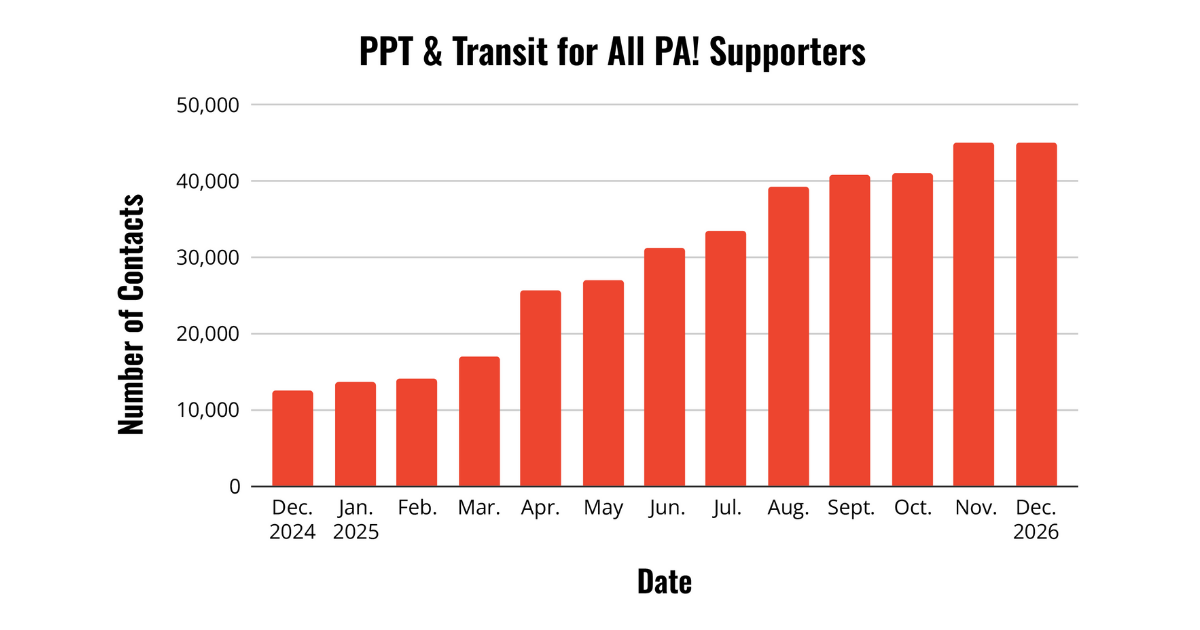
Thanks to the organizing prowess of PPT’s local and statewide members, our database contacts have grown an absolutely stunning 72% since December of 2024. That’s just over 32,500 people who joined the fight in 2025. Check out this (awe-inspiring!) graph that charts contact growth over the past year: 

Image Description: a graph of red bars showing the growth of PPT & Transit for All PA! supporters: from just over 10,000 in Dec. 2024, to around 45,000 in Dec. 2026.

If that data isn’t juicy enough for you, take a look at these other stats showing this massive growth: 

  • 350,000+: letters Pennsylvanians sent to their state legislators in support of robust, sustainable transit funding
  • 32,500+: new contacts added to the contact database in 2025
  • 350: Pennsylvanians who traveled to Harrisburg for a rally and lobby day supporting state transit funding (legislative partners told staff that this was the biggest rally they’ve ever seen at the Capitol!) 
  • 50: PA Senate districts with Transit for All PA supporters (yes, that means supporters in every single legislative district in Pennsylvania!) 
  • 100+: attendees at PPT’s 2025 National Transit Advocacy Spring Training (want to join in for Spring Training in 2026?)
  • 1500+: members of PPT, thanks to the new, more inclusive membership definition
  • 317: PPT members who contributed to our Year-End Member Drive to build new constellations of power
  • 41: members who started a monthly recurring dues-paying membership, sustaining transit organizing for the long haul

Most of all, our victory is in our clarity of purpose across so many differences. Our victory is in our smart, committed, caring community. Because the damn fascists are doing everything they can to divide us—by race, geography, by our abilities, by our income, by our nationalities. They wouldn’t try so hard if they weren’t so afraid of us, of how powerful we are together. 

In 2025 we built a new constellation of power here at PPT. We’ve won many things, but more victories can and must be on our horizon in 2026. 

In sum: cheers to you, to us, and to our collective liberation.

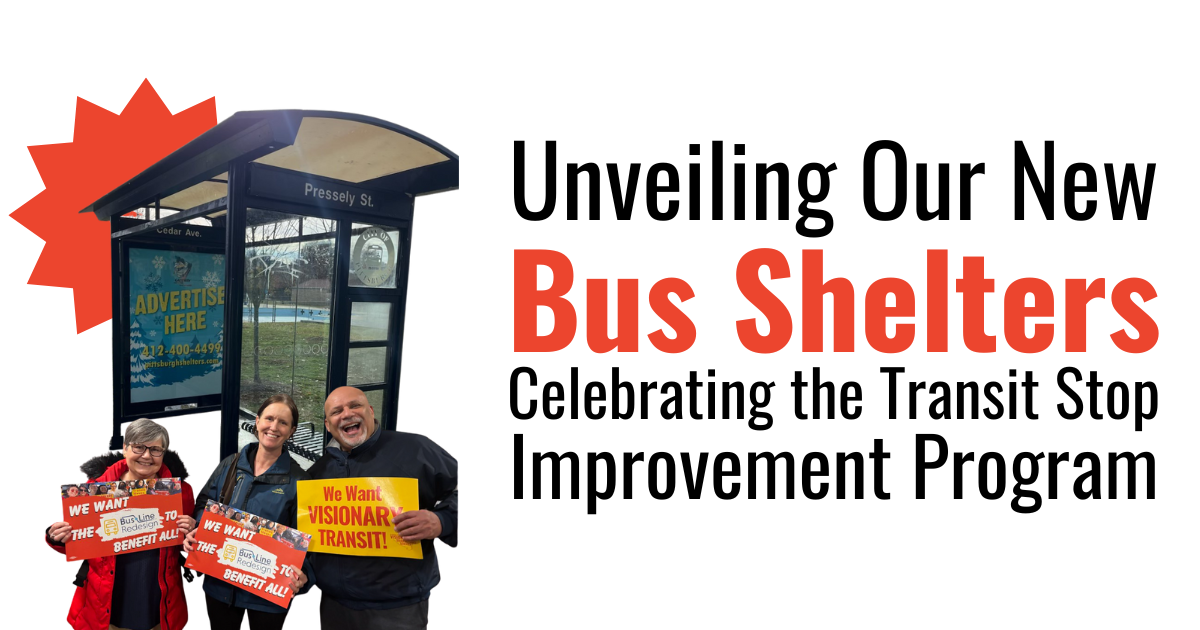
Unveiling Our New Bus Shelters: Celebrating the Transit Stop Improvement Program

Image Description: a bus stop titled “Pressely St.” decorated with a red starburst, and pictures of 3 PPT members holding rally signs and smiling. Black and red text reads “Unveiling our new bus shelters: celebrating the Transit Stop Improvement Program”.

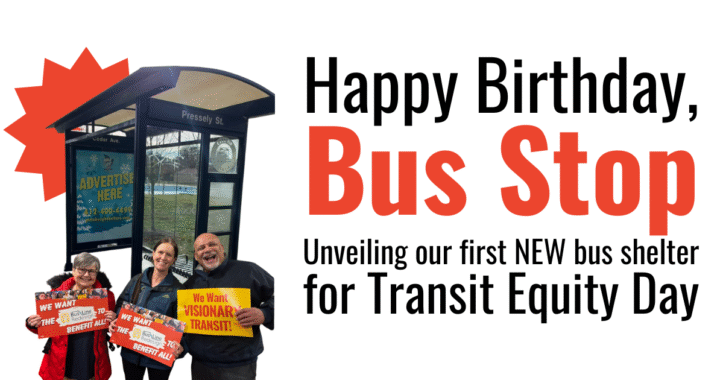
Join PPT and the City of Pittsburgh’s Department of Mobility and Infrastructure for a Bus Shelter Celebration on Feb. 4th, Transit Equity Day, and the 2-year anniversary of the launch of PPT’s Shelter Campaign. We will be celebrating the launch of the first new bus shelter created as a result of our organizing and partnership with the City of Pittsburgh! 

We will meet at the new shelter at the Cedar Ave and Pressley St inbound bus stop, on the City’s northside, sharing warm beverages, sweet treats, and reflections of the work we’ve done and the road yet ahead. There will be special speakers and opportunities to learn  about PPT’s upcoming infrastructure initiatives.

A Look Back at our Bus Shelter Campaign

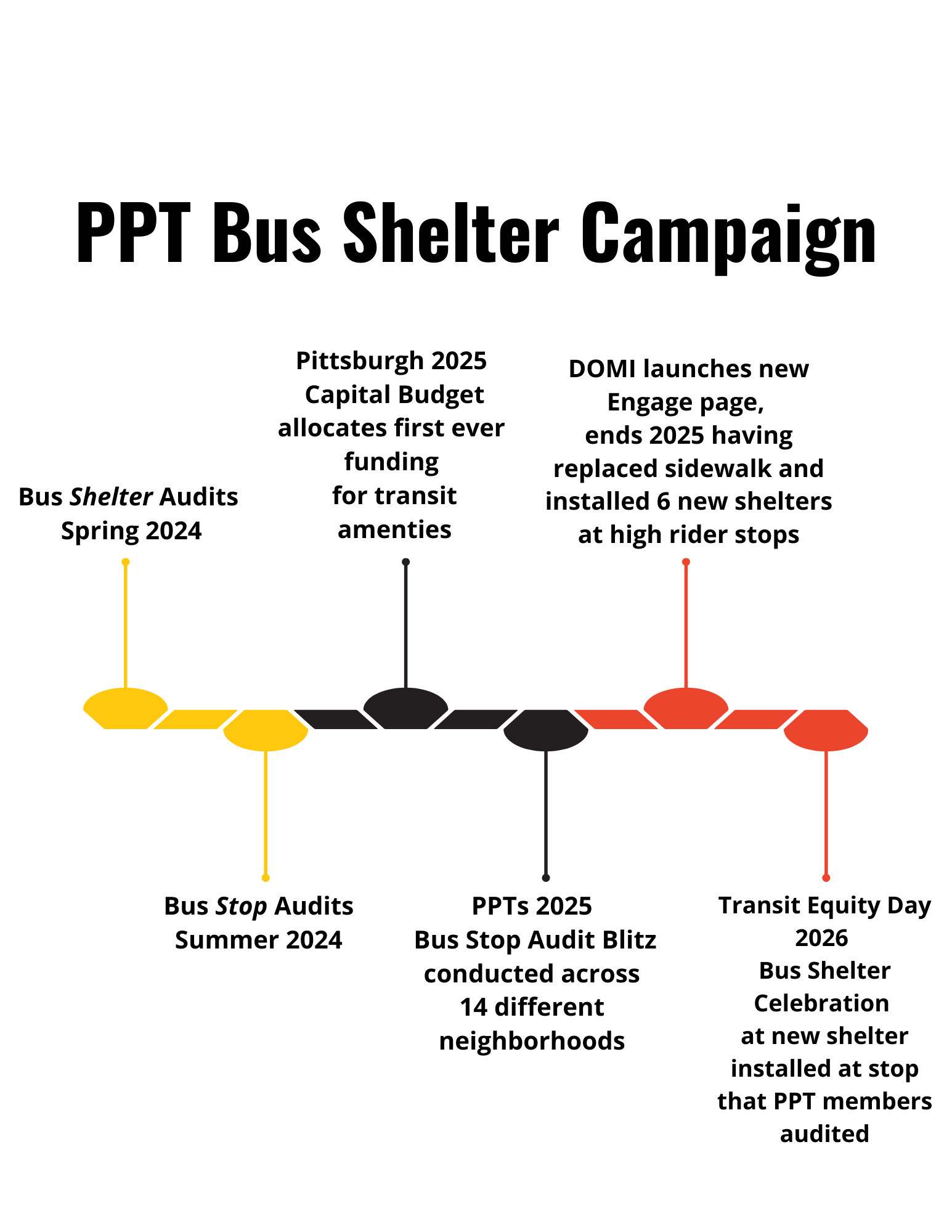
Image Description: a yellow, black, and red timeline graphic showing the progression of PPT’s Bus Shelter Campaign, from the first bus shelter audits in Spring 2024 to Transit Equity Day 2026.

When we last updated you, dear PPT members, we were launching our own 2025 Bus Stop Summer. This came after our first bus shelter victory – the allocation of funds for transit amenities in Pittsburgh’s 2025 Capital Budget, and the City of Pittsburgh’s 2025 Transit Stop Improvement Program launch. 

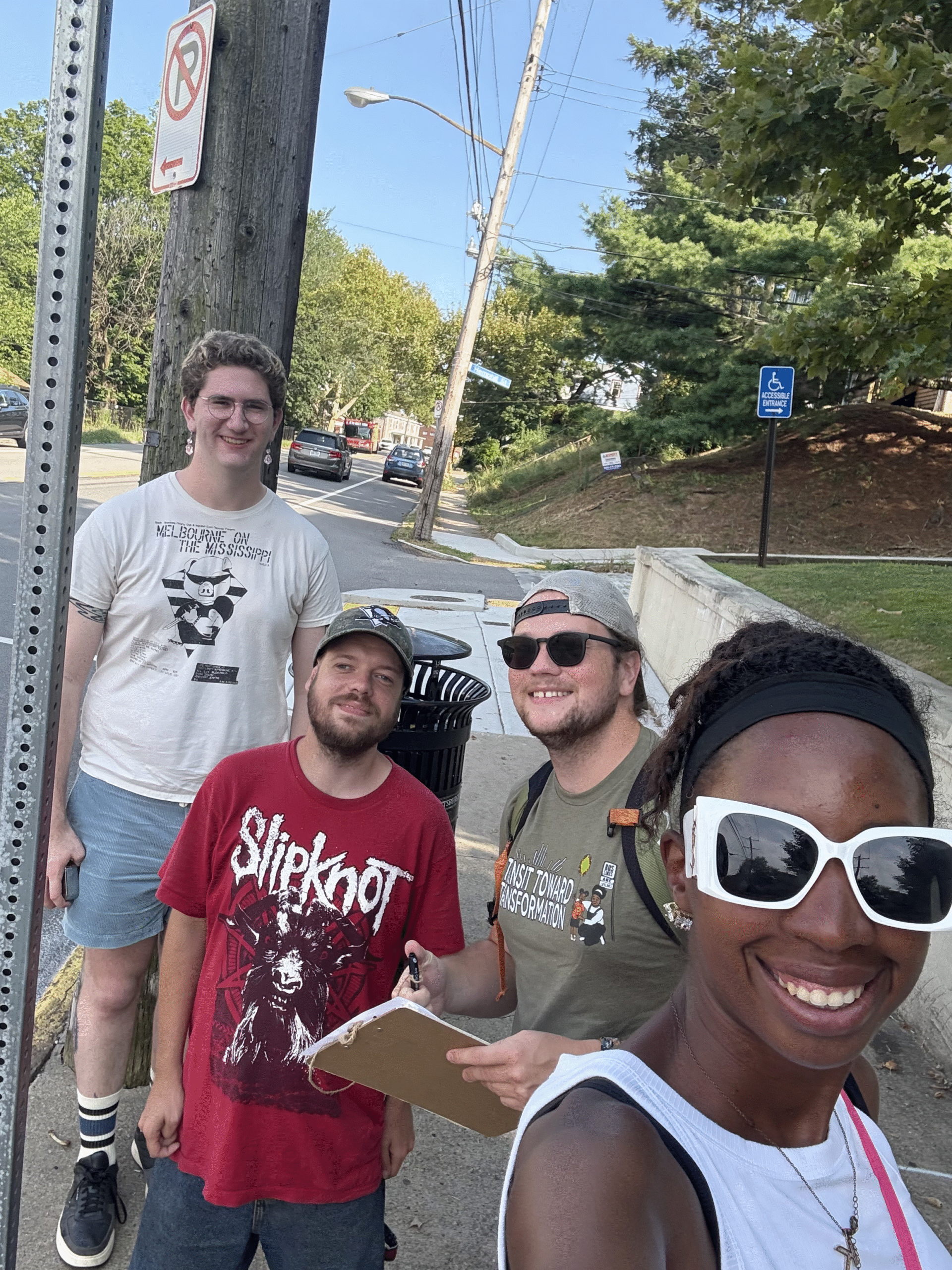
On a hot 90-degree day in July, four different teams of PPT members set out on a one-day Bus Stop Audit Blitz to help the Department of Mobility and Infrastructure (DOMI) gather information on the conditions of bus stops. The goal was to identify enough stops to rehome several “orphaned” bus shelters living at inactive bus stops throughout the city. 

29 high-rider stops across 14 neighborhoods in the city of Pittsburgh were visited. 10 of those stops were deemed eligible for bus shelters by PPT members who were trained according to Pittsburgh Regional Transit’s Bus Stop and Street Design Guidelines and DOMI’s criteria. This information was shared with the City to aid in their work.

Where we are now

DOMI’s 2025 Transit Stop Improvement Program allowed for the repaving of sidewalk pads at 6 high ridership bus stops and the subsequent installation of shelters at those stops. You can now wait for the bus in the shade and protection of shelters at the following bus stops:

  • Broadway Avenue at Hampshire Avenue (inbound)
  • Broadway Avenue at Hampshire Avenue (outbound)
  • Hamilton Avenue at Oakwood Street
  • Cedar Avenue at Pressley Street
  • Brighton Road and Woods Run Avenue
  • Sandusky Street and E. General Robinson 

As a part of this program, DOMI created an Engage page where transit riders can read the detailed criteria of what constitutes a bus stop eligible for a shelter, as well as recommend stops that need sidewalk improvements. The biggest takeaway from PPT’s bus stop audits has been that sidewalk conditions in the city are poor to fair at best, which prevents the easy installation of bus shelters, benches, and other amenities.

The success of PPT’s collaboration with DOMI has not only been in the Transit Stop Improvement Program, but also in the city of Pittsburgh thinking of bus stops in a bigger way; viewing them for the role they play in neighborhood connectivity at all levels of mobility, starting with safe sidewalk infrastructure.

You can always share with PPT which bus stops you think need a shelter through our This Stop Needs a Shelter form. We share this information with our friends at DOMI.

Join PPT and DOMI for a Bus Shelter Celebration on Feb. 4th, Transit Equity Day, and the 2-year anniversary of the launch of PPT’s Shelter Campaign. We will be at the new shelter at the Cedar Ave and Pressley St inbound bus stop, on the City’s northside, sharing warm beverages, sweet treats, and reflections of the work we’ve done and the road yet ahead. There will be special speakers and opportunities to learn about PPT’s upcoming infrastructure initiatives. 

ACTION ALERT: We Need Reliable, Robust Service that Serves Us

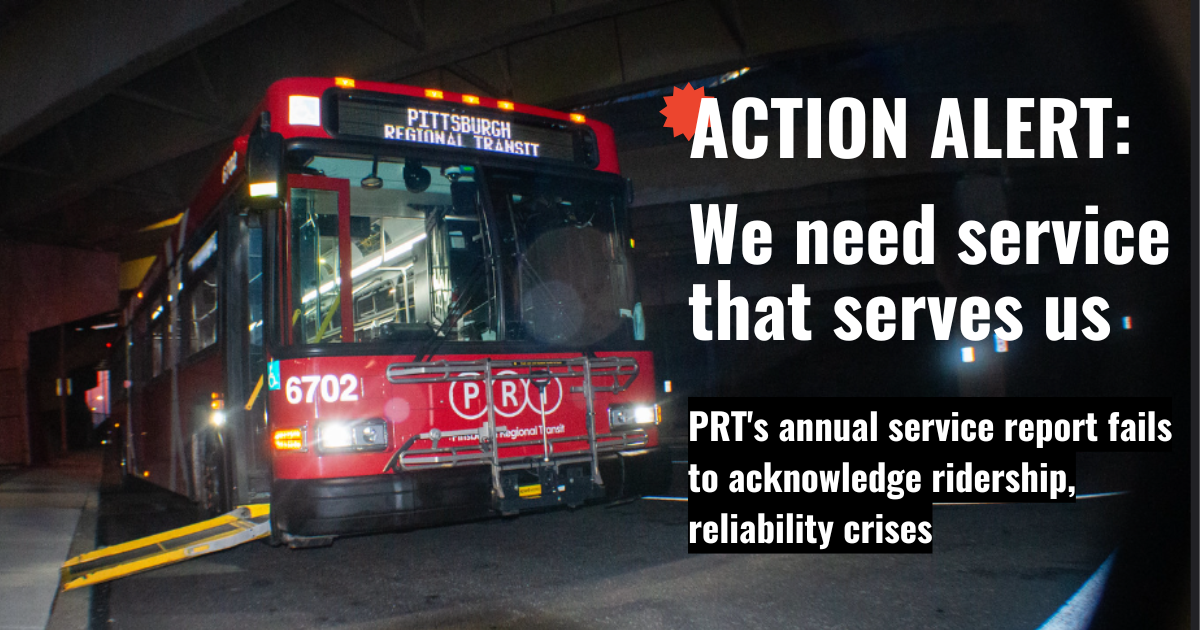
Image Description: a red PRT bus under a dark overpass at night, with its headlights on and ramp extended. To the right is white text reading “We need service that serves us: PRT’s annual service report fails to acknowledge ridership, reliability crises”, decorated with a red starburst.

We deserve a transit system worth fighting for. PRT’s ridership recovery post-COVID lags far behind its peers, and buses frequently don’t show up as scheduled. 

Pittsburgh riders have proved they’re ready to go to bat for PRT. Now PRT needs to grow ridership and to improve service reliability—and implementing the Bus Line Redesign now isn’t the answer.

State lawmakers from Allegheny County have a unique opportunity to push PRT for the baseline service improvements we need before overhauling the system with a Bus Line Redesign. Contact your legislator today to show them that we can, and must, improve our system now—with common sense baseline improvements, not a system redesign.


Last month, Pittsburgh Regional Transit (PRT) published its 2025 annual service report, laying out data about ridership levels, operating costs per rider, and transit service reliability. From the tone of the report, one might assume that our transit system is doing fine, with any service reliability or ridership hiccups due to unique issues like construction, worker shortfalls or commuter changes post-pandemic. 

However, this report actually shows that Pittsburgh Regional Transit is doing worse on ridership recovery and service reliability compared to transit agencies across the country. The 2025 annual service report disclosed that PRT ridership has plateaued and declined this year from last, for the second year in a row. 

PRT ridership is now only about 60% of pre-COVID levels, a national anomaly. 

On average, US transit systems have recovered 85% of 2019 ridership, and are continuing to climb every year. Some agencies have even surpassed pre-pandemic ridership by making targeted service improvements, and/or advancing new fare programs like their employer passes or low-income and zero fare programs. Notably, over the past two years, PRT has conspicuously removed all comparative data with other peer transit systems, which was a staple of the report in years prior. 

PRT service reliability has also plateaued, with an average of only 66% of buses arriving on time. We’ve said many times, and will continue to say, that this is because of unrealistic written schedules and not due to transit worker shortcomings. 

As some particularly egregious examples, here is the average service reliability of some of the highest ridership routes in the city in 2025:

  • 28X Airport Flyer- 58%
  • 58 Greenfield- 50%
  • 61A North Braddock- 50%
  • 61B Braddock-Swissvale- 50%
  • 61C McKeesport-Homestead – 44%
  • 64 Lawrenceville-Waterfront-    57%
  • 65 Squirrel Hill-    46%
  • 71B Highland Park-  41%
  • 74 Homewood-Squirrel Hill-    57%
  • 81 Oak Hill-    55%
  • 82 Lincoln-    54%
  • 83 Bedford Hill-    54%
  • 91 Butler St-    58%

On top of this, schedules show far fewer bus stop arrival times (“time points”) on the printed schedule than in years prior, so the evaluation of whether buses are “on-time” is happening only at a handful of stops on any given route. The lack of time points—and PRT’s minimal accountability to this metric—make it additionally hard for riders to anticipate arrival times for the majority of bus stops, and to plan transfers between routes. 

PRT’s service reports have failed to register the gravity of our ridership and reliability crisis, excusing them as the result of various one-off issues. There is no reason identified in the 2025 report for our low, plateauing on-time-performance average this year, and therefore no presumed mechanism for improving it. (Last year, the 2024 PRT annual service report did note the short-turning of 71 buses and the 61D in Oakland as a major contributor to our region’s precipitous transit ridership drop and bus crowding, but  then proceeded to do nothing about it.)

Despite this, thousands of riders proved this year that they are willing to stand up and fight for PRT.  We need our efforts to be matched with efforts from PRT. They must improve its service to ensure that we have a system worth fighting for. 

Riders need action from PRT, but implementing the Busline Redesign Draft 2.0 is not the solution to our ridership and reliability crisis.

We agree that change is needed. It’s vital that Pittsburgh Regional Transit make changes to address their concurrent ridership, service reliability and funding crises. However, implementing the Busline Redesign before fixing the basics will only make these problems worse.

When you ask PRT why we are lagging so far behind our peers, they will say that the Bus Line Redesign will solve our issues. But that is avoiding the core of the problem – service reliability has been far below its goals for years, and our ridership has declined while others have bounced back. Many agencies have successfully recovered ridership since the pandemic, but not by upending their existing bus network. 

Moreover, we are deeply concerned that implementing a “cost-neutral” bus network redesign will lock in the 20% service cuts that we’ve endured these last 5 years—and may not even be fully implemented, given the lack of any sustainable state funding solution.

We’ll have a more in-depth blog published in the next few weeks that gets deeper into the issues we see with the Bus Line Redesign. 

Instead of a complete redesign, transit riders and workers and our region need PRT to put forward goals and a vision for increasing ridership, increasing access to transit, restoring service, and for improving service reliability. 

As a starting point, Pittsburgh Regional Transit should set goals around ridership recovery, report monthly on their progress, and leverage all the tools at their disposal to grow ridership. In particular, PRT should be capitalizing on the fare programs Allegheny Go (which gives them 100% of fare revenue for every trip!) and the PRTner pass. We have also been calling on PRT and the County to fund free fare days using resources from the Regional Asset District or the County’s Clean Air Fund. Imagine if PRT supported new riders to take the system for one day with transit ambassadors, without the cost or process burden of learning the fare payment system!

Around service reliability, Pittsburgh Regional Transit needs to implement best practices around scheduling. Namely, they need to ensure that service frequencies and times are:

  • Consistent between schedule changes
  • Realistic for transit operators to drive
  • Legibly communicated to everyday people
  • Accurate across the printed timetable, apps, and bus stops

The lag and decline of our ridership recovery has likely been due to a combination of self-inflicted wounds: years of unreliable service, PRT’s thrice yearly schedule changes that regularly upend dozens of routes, misaligned communications about stop and service changes, the on-going bus stop eliminations, and the ongoing service cuts. Because these are the results of PRT’s existing practices, these same tools are also available for them to fix our ridership woes, now.

Thousands of riders have shown they are willing to support our agency. Now it’s time for PRT to give riders a system that our region can be proud of.


Take action: Tell legislators that PRT can fix fundamental service and ridership issues now!

Build new power during PPT’s Member Drive!

Image Description: an illustrated Pittsburgh skyline at night, in deep purple and blue with yellow lights. The night sky is deep purple with a lighter purple illustration of Pittsburgh’s three rivers. Above the skyline is handwritten light yellow text reading “PPT’s 2025 Year End Member Drive: Building new constellations of power”, decorated with yellow and light yellow stars.

Here at PPT, we’re building new constellations of power. We’ve faced bigger threats to our system, and grown our movement more, than ever before.

There’s never been a better time to join the fight for better transit for all. Will you support transit justice for you and your neighbors with a membership donation to PPT?

PPT’s Year End Member Drive is here!

Membership dues help PPT pay for direct actions, advocacy, and everything else needed to fight for affordable, reliable, dignified transit across our region. Our annual Year-End membership drive is our most important fundraiser of the year.

But this year, there’s a special twist:

Every contribution to our 2025 Year End Membership Drive will be matched up to $20,000 by a local foundation.

If you donate $5, it’ll magically become $10. $500 will become $1,000!

In a year of such fantastic growth, your donation has never been more important—and now it will go even further! Can you help us make our dreams a reality by donating to become a member?

PPT members build their skills to win campaigns. Why is PPT membership so powerful? Read member Kristen’s story.

A selfie of PPT member Kristen Greene, with a purple cutout shape background. She is wearing matching leopard print glasses and headband, and smiling at the camera.

My name is Kristen Greene, and I’m pretty new to PPT. I first got involved in January 2025, when I took a selfie in support of statewide transit funding. I never could’ve dreamed that sharing that selfie would lead to me starting, and winning, a campaign for better transit!

Everything changed this summer, when I found out that the Waterfront mall wanted to remove bus stops from its stores. I had just finished PPT’s transit organizing fellowship for Mon Valley residents, so I knew just how many people rely on transit to get their groceries there. I had to do something. I told PPT about the cuts, and they asked me to speak about them on the news.

Here’s the thing: I do not like public speaking. But this was important, so I stepped out of my comfort zone and did an on-camera interview with WPXI. After my interview aired, over 1,400 people signed a petition to stop the cuts–and 5 days later, the Waterfront announced that it would keep bus stops on the property!

It is such a good feeling knowing that I made a difference! PPT helped me step out of my comfort zone, and then we actually won our campaign. When I think about everything we’ve accomplished–whoa! I’m so proud of myself, and I’m so proud of us. PPT helped me make our transit system better for everyone. They showed me that when we fight together, we build our power–and we win! We can’t do it without you. Can you join me in this fight?

In Solidarity, 
Kristen Greene

Party down with us at our 2025 Transit Justice Victory Party!

Image Description: white text on a dark purple background reads “PPT’s Year End Transit Justice Victory Party”, with the PPT logo below. The graphic is illustrated with yellow star-shaped lights strung across the top of the frame

We’ve accomplished so much this year, all in service of new transit rider and worker power. Party down with us as we celebrate and build our visions for next year!

From Pittsburgh to Harrisburg and all across PA, 2025 has been a year of stunning growth for our movement for Transit Justice. It’s time to celebrate the love-filled community that makes it all possible—with yummy food, music, dancing, and the best company around.

Tickets to this party are offered on a sliding scale pricing basis. We suggest a $20 donation, but no one will be turned around for lack of funds.

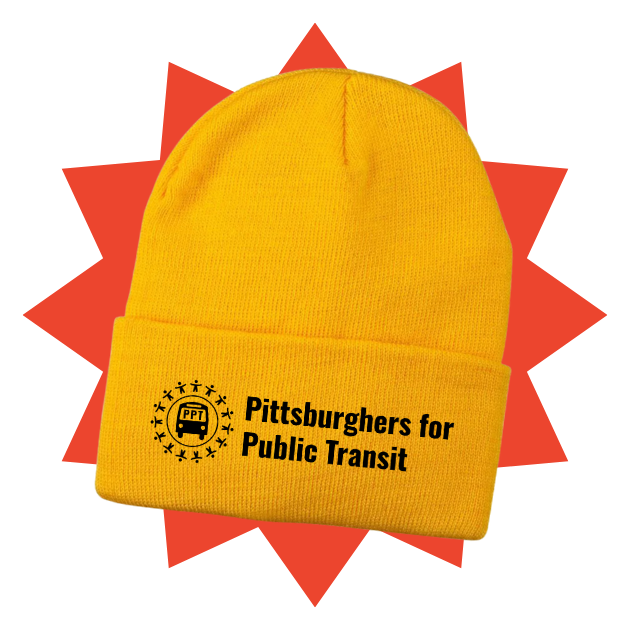
This year, we are offering a FREE PPT-branded golden beanie to everyone who reserves a ticket for $30 or more. Don’t miss out on this deal!

What to expect

What, When, & Where

Friday, December 12, 2025, 6:00-9:00 PM
Hosanna House’s Wallace Event Center
807 Wallace Ave, Pittsburgh, PA, 15221

We’ll be inside at the Wallace Event Center at Wilkinsburg’s Hosanna House. We’ll have a DJ playing music, space to dance, and tables and chairs serving dinner for all those who reserve a ticket. We’ll have a brief speaking program where PPT members talk about our wins from the year, and what it means to build power with this community.

Attendees should not feel obligated to attend the entire event, so feel free to arrive and leave at times that work best for you.

Food

We will be providing a catered meal from Aladdin’s to all those who pre-register for this event. We will clearly label all major allergens on the food.

Our menu will be:

  • Falafel (GF, Vegan, contains nuts), Tabouli (vegan), Hummus (GF, vegan), Baba Ghannouj (GF, vegan), Loubie Bzeit (GF, vegan)
  • Hot rolled pitas with a choice of Chicken Shawarma, Chicken Curry, Aladdin’s Beef Kabob, Arayiss (Beef), or Cauliflower (vegan, contains nuts)
  • Fresh salad (GF, vegan, may contain nuts)

Guests are welcome to bring a dessert to share if they wish! We just ask that they label ingredients or major allergens of anything they bring to share, so that folks can assess what is safe to eat for them.

Accessibility

The space is on the second floor, with an elevator running between floors. All spaces are accessible, including restrooms near the event space. There is consistent lighting throughout the space, which may be turned down a bit for dancing and speeches. There will likely be some loud portions of the evening, as we dance to music and have lively conversations with our neighbors.

We will be providing childcare at this event. Please indicate on your ticket form if you would like childcare for someone in your party.

Getting there

Please enter the building through the Wallace Ave. entrance, and head up to the second floor.

There is a bus stop right in front of the main entrance, serving the 67, 69, 79, P17, and P67 buses. There is also a stop 3 blocks away, which serves the 71D, 86, and P71. The venue is about a mile away from the Wilkinsburg East Busway stop.

There will be street parking available, as well as 3 parking lots at Wallace and Mill St., Wallace and Center St., and Mill St. and North Ave. All of these lots are within a block of the venue.

Volunteering

If you’re interested in volunteering, check the box at the end of the RSVP form, and an organizer will reach out to you to confirm details.

This is a community event, and we need help to make it a success! We have several volunteer shifts available for those interested in helping out. Don’t worry, you’ll still get a chance to eat, drink, and relax if you volunteer!

Volunteers may help out with:

  • Set up crew: meet at the PPT office in Shadyside before the event to help pack and transport materials to the venue. Requires a vehicle and some ability to lift/move supplies using stairs.
  • Check-in and welcome table: reference a spreadsheet to check guests in; record information of unregistered guests; take donations via cash/card
  • Strategic plan table: explain our draft 2026 Strategic Plan to guests, and help them vote on the draft
  • Food station: help guests place their desserts on the table, replace cups/utensils, check on other volunteers and bartender to make sure they’ve eaten
  • Floater: check in with childcare professionals to see if they need a break; assist with miscellaneous needed tasks, such as cleaning up spills and assisting PPT staff
  • Wayfinding: on standby to meet PPT members at nearby bus stops if they need someone to show them to the venue
  • Photographer: take fun, engaging pictures of people at our event! Requires some mobility to move around the event space.
  • Clean up crew: take down decorations, collect trash, and pack up vehicles after the party concludes

RSVP to Join Us

VICTORY: PRTner Pass passes for City Employees!

Image Description: A group of advocates stands with Pittsburgh City Councilmembers inside council chambers. They smile and hold Transit for All PA! and Week Without Driving PGH signs, as well as a large proclamation bearing the City seal. Black and yellow text reads “VICTORY: FREE transit passes won for City Employees!”

UPDATE: The PRTner Pass discounted bulk fare program has officially passed the City budgeting process! That means all Downtown employees at the City of Pittsburgh will now receive FREE transit passes as an employment benefit, and that PRT will receive this steady source of funding. We would like to thank everyone who sent a letter of support, Councilperson Barb Warwick, and the City of Pittsburgh for becoming a leader among our local employers and institutions in demonstrating the value of this program.

If you are a Downtown City of Pittsburgh employee, stay tuned here and to your HR representatives to learn more about how to enroll in the program.

This year, the Pittsburgh City budget proposed for the first time to include funding for the purchase of transit passes of all downtown City employees through Pittsburgh Regional Transit’s PRTner pass. This is a huge deal, enabling 750 municipal workers to be given free transit passes as an employment benefit, and making the City of Pittsburgh a leader in modeling the benefits of the program for other regional employers and institutions.

What is the PRTner Pass?

At the end of last year, Pittsburgh Regional Transit rolled out the new PRTner pass program after receiving overwhelming support through its public comment period. It enables the bulk purchase of transit fares for employers, developers and school districts to pay for passes for their constituencies at the deeply discounted rate of $28/per person monthly. 

The PRTner pass has the potential to provide low-income and working class people (renters, students, employees) across Allegheny County unlimited transit access—freedom of movement—that will both save money on their existing transit trips and incentivize more travel by transit. Moreover, it will increase the amount of dedicated operating revenue for PRT, through new transit fare payments by corporations and developers, large non-profits, school systems and now municipalities like the City of Pittsburgh.

 In our challenging political climate, it’s hard to win new revenue for restoring and expanding transit service, particularly through progressive means. The PRTner pass is a unicorn funding opportunity- growing transit equity, transit ridership, transit revenue, and sourced from corporations and major institutions! Win win win win!

And there’s massive potential for growth – at SOUND transit in Seattle, where a similar program has existed for years, more than half of the transit agency’s total revenue is generated from a bulk discount fare program like the PRTner pass.

To affordable fares—and beyond!

Now, the PRTner pass purchase for City employees is only the first step. It’s important that more employers and developers are incentivized to participate. That is one piece of why we have been organizing in support of the Mayor’s Housing and Zoning Code Package, which include incentives for developers and employers to mitigate their commuter impacts through PRTner pass purchases. 

This program has long been an organizing goal of riders! There is a big demand by employers, schools and developers to provide a benefit similar to the student pass programs at CMU, Pitt and Pittsburgh Public Schools. Since 2019 and the launch of our Fair Fares Platform, PPT has called for Pittsburgh Regional Transit to offer common-sense fare products (we called them “fare incentive programs”) that would increase both revenue and ridership for the agency. 

We have envisioned opportunities for large employers like UPMC to purchase passes for their workers, helping ease some of the transportation costs on our region’s healthcare staff and reducing the need for shuttles and parking lots that increase congestion and disallow more housing or commercial developments in the city. For service employees like those at Giant Eagle or janitors in the downtown office buildings, monthly transit passes could be a substantial commuter benefit, but it could also be used for all sorts of necessary trips outside of the workplace- for recreation and childcare, for grocery shopping and healthcare appointments. 

At the Giant Eagle Shakespeare site at Shady and Penn, we have organized since 2018 for bulk passes to be purchased for all renters in the future housing development, to reduce the demand for structured parking, and to increase transit usage in one of the most transit-rich corridors in the County. This demand was included in our 100 Days Transit Platform for Mayor Gainey in 2021 and our Riders Demands for the Next County Executive in 2023. And in February 2024, we made bulk discount employer fares- like this PRTner Pass proposal- a cornerstone of our goal to have elected officials play their part to fund transit at all levels, by calling on the City of Pittsburgh and Allegheny County to purchase passes for their employees

We’re now seeing the fruits of that organizing- and we’re just getting started.

Build the Future of Transit Justice: Help Shape PPT’s 2026 Strategic Plan

Image Description: An illustration of an orange and yellow bus, decked out with smiling passengers, and with its destination sign reading “future”. To its right, in front of starbursts and cartoon stripes, is black and white text reading “The Future of Transit Justice: PPT’s 2026 Strategic Plan”.

Every year, our grassroots union engages in a collaborative planning process to chart a path for our growth in the coming year. PPT’s members help us brainstorm ideas for our internal organizational development, creating goals for how we support our members and build up the PPT family. We also brainstorm ideas for campaigns we can take on to win improvements for transit riders and communities–things like making fares more affordable, improving service, or building better sidewalks and more affordable housing. 

This is an ongoing collaborative process between our membership, committees, board, and staff. This is what makes our work so special: every PPT member, whether they’ve paid dues or shown up to support us at rallies and events, has a voice in our strategic plan.

I’m a PPT member, how can I give feedback?

Below are 6 target areas we want to focus on in 2025, and some ideas for specific goals within each area. We want to hear your input on them, so please share your opinions and wisdom below.

For each of the 5 campaign topics (Fares, Service, Infrastructure, Funding, #VoteTransit), consider these questions as you give your feedback:

  • What needs to be changed or added to this plan? 
  • What parts feel particularly aligned with PPT? What parts get you fired up for the year to come?
  • What seems most important to prioritize over the coming year? 
  • How will we measure success?

All feedback is welcome–after all, you’re the expert on your own experience riding local transit!

For each step, share any thoughts you have about the listed target area and goals. If you don’t have anything to write, just write “n/a”.

Fill out this form to help us brainstorm PPT’s 2026 Strategic Plan: